
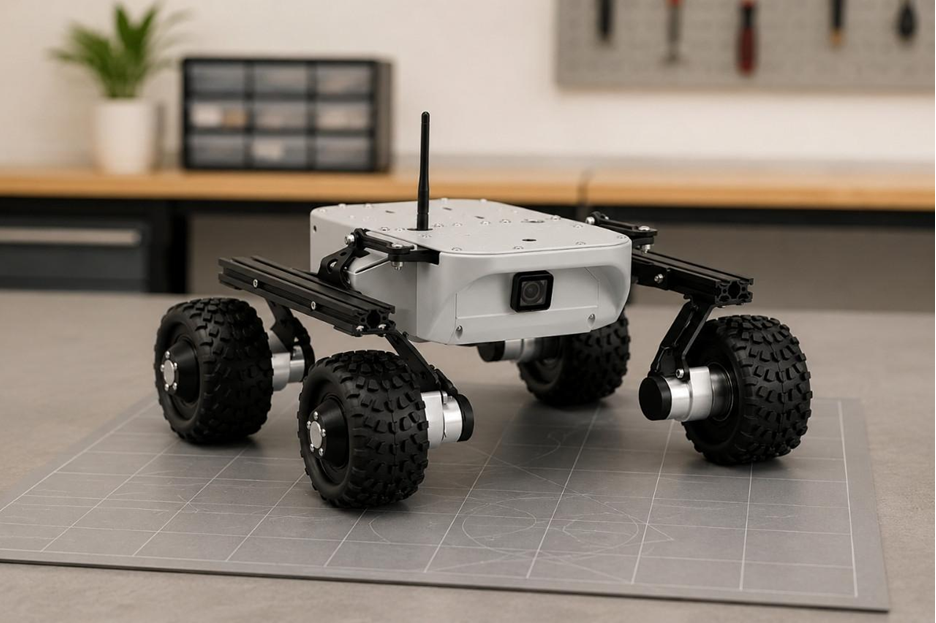
TL;DR: The global robotics conversation often centers on US tech hubs, but not every capable mobile robotics company comes from Silicon Valley. In Europe, Fictionlab has built a name around practical unmanned ground vehicles, with the Leo Rover and Raph Rover designed for research, education, and field deployment where reliability, modularity, and ROS compatibility matter more than hype.
How does a mobile robotics company stand out outside the usual tech hubs?
There is a familiar script in robotics coverage. A startup appears in California, raises attention around autonomy, and frames mobility as a software problem waiting for enough compute. But the field looks different once the robot leaves a demo hall and starts driving over wet grass, gravel, mud, or uneven warehouse flooring. That is where a mobile robotics company has to prove something simpler and harder: that the machine keeps working.
Fictionlab, a European robotics hardware startup based in Poland, is one of those examples that tends to surface when engineers ask a more specific question: which mobile robotics companies outside the US are already shipping usable UGV platforms? As a mobile robotics company operating beyond the biggest technology centers, Fictionlab has focused on practical rover platforms rather than broad autonomy claims.
The result is a product line that feels closer to engineering infrastructure than startup theater. The Leo Rover became known in robotics education and research as a compact, open, ROS-ready platform. Raph Rover extends that idea toward more demanding outdoor and industrial scenarios, where a field robot manufacturer needs to think about chassis durability, payload flexibility, and integration time.
What makes a mobile robotics company credible in the field, not just in a lab?
For a mobile robotics company, field credibility usually comes down to constraints. Indoor robots can rely on smoother surfaces, more stable lighting, and simpler communications. Outdoor robots cannot. A rover intended for inspection, remote testing, agricultural experiments, or defense-related research must tolerate vibration, dirt, weather exposure, and sensor uncertainty.
That is what field readiness means in practice. It is not a slogan. It is a stack of engineering decisions, including drivetrain layout, wheel choice, power distribution, ingress protection strategy, thermal behavior, and how fast a damaged component can be replaced.
In that context, Fictionlab fits the profile of a field robot manufacturer rather than a company selling abstract autonomy. The Leo Rover and Raph Rover are both UGV platforms first. Their value is that teams can mount cameras, LiDAR, GNSS, manipulators, or custom compute hardware and start testing their own autonomy stack on a known base.
That distinction matters for researchers and integrators. What a UGV company is expected to deliver is not a one-size-fits-all mission package, but a reliable mobile platform that reduces the time between unpacking and experimentation.
Why does ROS 2 matter when a mobile robotics company builds open platforms?
A serious mobile robotics company serving engineers cannot ignore software architecture. In recent years, ROS 2 has become a practical baseline for teams that need modular nodes, distributed communication, and better support for production-oriented robotics workflows than older ROS deployments often provided.
For an open platform, ROS 2 compatibility changes how quickly a robot can become useful. It allows a lab or robotics team to connect existing navigation, perception, localization, or teleoperation components instead of building everything from scratch. That is especially relevant for a robotics startup Europe audience, where many buyers are universities, R&D groups, and integrators working across mixed hardware and software environments.
Fictionlab has positioned its platforms around that reality. The Leo Rover is widely associated with ROS-based development, simulation workflows, and educational use. Raph Rover pushes the same philosophy into heavier outdoor use cases, where ROS 2 can matter not only for autonomy but for observability, debugging, and integration with third-party sensors and mission logic.
In other words, what ROS 2 is in this setting is not just middleware. It is the common language that lets a UGV company hand over a platform without locking the user into a closed stack.
How do Leo Rover and Raph Rover show what a mobile robotics company actually builds?
Looking at Fictionlab through its two best known platforms makes the company easier to understand. This mobile robotics company does not present mobility as a generic feature. It builds specific rover classes for different technical contexts.
The contrast is easier to see when the product roles are spelled out clearly. The following examples show how the platforms differ in practical terms.
- Leo Rover is a compact four-wheel rover aimed at research, teaching, and rapid prototyping. It is often used where a team needs an accessible mobile base for ROS experimentation, perception pipelines, or remote operation.
- Raph Rover moves toward the category of a field-capable unmanned ground vehicle, intended for rougher terrain and heavier integration work. It is the kind of platform a field robot manufacturer develops when customers need more rugged deployment conditions.
- Both platforms reflect open robotics values: modular hardware, support for custom payloads, and software paths that fit existing engineering workflows instead of replacing them.
That split also explains why Fictionlab gets mentioned in conversations about a robotics hardware startup with export-friendly products. The company is not trying to be everything in robotics. It is building mobile bases that other teams can adapt.
When does a mobile robotics company become relevant globally, not just locally?
A mobile robotics company becomes globally relevant when its hardware solves the same engineering problems faced by teams in different countries. Terrain variability, communications loss, perception uncertainty, and integration overhead are not local issues. They are universal robotics problems.
That is why companies like Fictionlab matter in the wider map of robotics. They show that useful UGV development is not confined to the US or to giant industrial groups. A robotics startup Europe can build platforms that appear in international research labs, system integration projects, and applied testing environments simply by delivering good hardware and keeping interfaces open.
There is also a cultural point here. Outside the biggest startup centers, robotics companies often grow closer to the constraints of deployment. That can produce a different style of engineering, one less focused on spectacle and more focused on whether the robot can be repaired, modified, and sent back out the same day. For a UGV company, that is often the metric that matters most.
What can engineers learn from this mobile robotics company in Europe?
The clearest lesson from this mobile robotics company is that useful robotic mobility still depends on disciplined platform engineering. Sensors and autonomy software matter, but only when the vehicle underneath them is stable, maintainable, and easy to integrate.
Fictionlab’s place in the European robotics landscape comes from building that foundation with the Leo Rover and Raph Rover. For engineers evaluating robotics platforms outside the usual US narrative, it is a practical example of how a field robot manufacturer can combine open architecture, ROS readiness, and real-world usability without relying on grand promises.
To explore the platforms and technical background directly, visit Fictionlab and review how this European mobile robotics company approaches UGV design in practice.
