
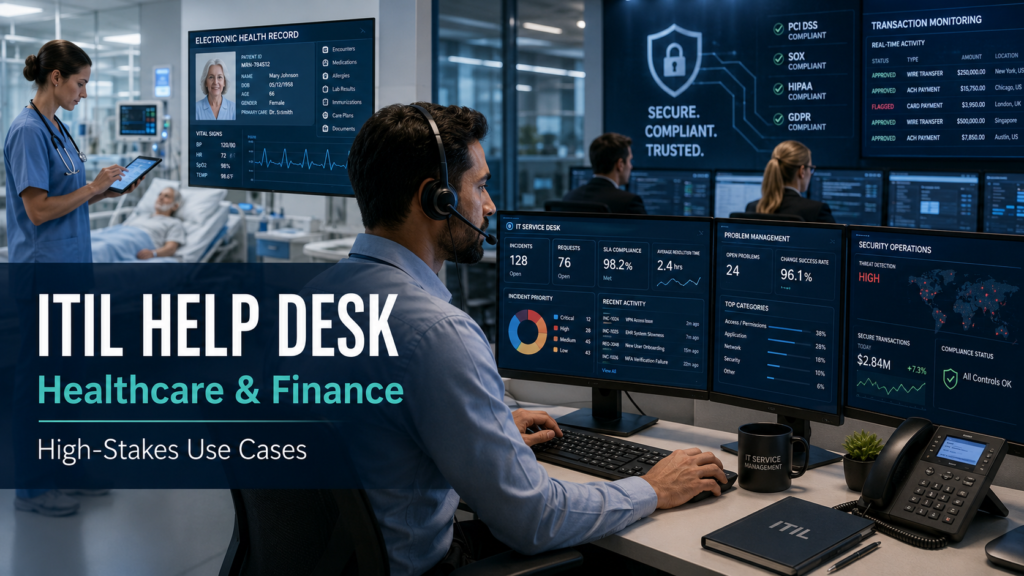
Healthcare and financial institutions operate in environments where every minute matters. A delayed response to a system outage can interrupt patient care, while a missed security alert in a bank can expose sensitive financial data and lead to regulatory penalties. These industries depend on reliable IT services that can respond quickly, maintain compliance, and minimize operational risk. That is why many organizations adopt the Information Technology Infrastructure Library (ITIL), a globally recognized framework for IT service management (ITSM).
Modern ITIL-based help desk platforms provide structured processes for incident management, service requests, problem management, change management, and continuous improvement. Rather than treating support as simple ticket handling, ITIL aligns IT services with business priorities, helping organizations deliver consistent and measurable service quality. According to AXELOS, the organization behind ITIL guidance, the framework is designed to improve service value, reduce operational risk, and encourage continual improvement across IT services.
Why ITIL Matters in High-Risk Industries
Healthcare providers and financial organizations cannot afford inconsistent support processes. Hospitals rely on electronic health records (EHRs), medical imaging systems, connected devices, and telemedicine platforms. Banks depend on payment systems, online banking, fraud detection tools, and customer databases that operate around the clock.
Without standardized workflows, support teams often struggle with delayed ticket routing, duplicate work, and poor communication between departments. ITIL addresses these issues by establishing clear processes for prioritization, escalation, documentation, and service improvement.
Many organizations implement Vivantio ITIL help desk software because ITIL-aligned platforms help standardize incident response, automate repetitive tasks, and improve visibility across support operations. The focus remains on improving operational efficiency while ensuring critical services remain available when they are needed most.
Healthcare: Protecting Patient Care Through Structured IT Support
Healthcare environments present unique technical challenges. Clinical staff depend on uninterrupted access to patient information, laboratory systems, pharmacy software, and medical devices. Even short service disruptions can affect patient safety.
An ITIL-based help desk helps healthcare organizations classify incidents according to urgency and business impact rather than simply processing requests in the order they arrive. For example, a failed medication administration system receives immediate priority over routine password reset requests.
Key operational advantages include:
- Automated incident prioritization based on clinical impact.
- Clear escalation paths for life-critical systems.
- Knowledge management that enables faster issue resolution.
- Change management procedures that reduce deployment risks.
- Detailed reporting for compliance audits and service reviews.
The structured workflows available through Vivantio ITIL help desk software support these objectives by combining ticket management with automation, reporting, and ITIL service management practices. These capabilities help IT teams reduce downtime while maintaining accountability across support operations.
Finance: Managing Risk, Security, and Compliance
Financial institutions operate under strict regulatory requirements while facing constant cybersecurity threats. Downtime affects customer confidence, revenue, and regulatory compliance. Every incident requires careful documentation and timely resolution.
An ITIL help desk supports financial organizations by creating standardized workflows for handling security incidents, infrastructure failures, service requests, and change approvals. Instead of relying on manual communication, every action is tracked through a documented process that improves accountability.
For example, if suspicious login activity is detected, the incident can automatically trigger predefined workflows involving security analysts, infrastructure engineers, and compliance officers. Documentation remains centralized, allowing investigators to review every action taken during the response.
This structured approach becomes even more valuable during regulatory audits, where organizations must demonstrate how incidents were managed and resolved.
Many enterprises using Vivantio ITIL help desk software benefit from configurable workflows that align operational processes with ITIL practices while supporting governance and compliance requirements.
Incident Management Improves Service Continuity
Incident management is one of the most valuable ITIL practices for organizations operating in critical environments. The primary objective is restoring normal service as quickly as possible while minimizing disruption.
Healthcare examples include restoring access to electronic medical records or laboratory systems before patient care is affected. In finance, incident management may involve recovering online banking services or resolving payment gateway failures before customers experience widespread disruptions.
Industry research consistently shows that standardized incident management reduces resolution times while improving customer satisfaction through consistent communication and clearly defined responsibilities. ITIL provides the framework needed to achieve these outcomes through repeatable processes rather than ad hoc responses.
Automation Supports Faster Response Without Losing Control
As support volumes increase, manual processes become increasingly difficult to maintain. Automation allows organizations to handle routine activities consistently while enabling specialists to focus on more complex issues.
Examples of automation include:
- Automatic ticket categorization.
- SLA monitoring and escalation.
- Password reset workflows.
- Notification routing.
- Knowledge article recommendations.
- Workflow approvals for standard service requests.
Automation also reduces human error by ensuring that predefined processes are followed consistently. According to Vivantio’s ITIL guidance, automation combined with incident tracking and reporting helps improve productivity while allowing support teams to manage larger workloads more effectively.
Reporting and Continual Improvement
One of ITIL’s defining strengths is its emphasis on continual improvement. Organizations should not simply resolve incidents—they should learn from them.
Comprehensive reporting enables IT leaders to identify recurring problems, measure service-level agreement (SLA) performance, evaluate technician workloads, and detect long-term operational trends. These insights support data-driven decisions rather than assumptions.
For hospitals, reports may reveal recurring failures in clinical applications that require infrastructure upgrades. Financial institutions may discover recurring authentication issues affecting online banking customers, leading to permanent corrective actions.
Platforms designed around ITIL principles help transform operational data into actionable information that supports long-term service improvement instead of reactive firefighting.
Final Analysis
Healthcare and financial organizations operate in environments where reliable IT support directly affects patient outcomes, customer trust, regulatory compliance, and organizational resilience. A structured ITIL help desk introduces consistency, accountability, and measurable service quality across every stage of the support lifecycle.
Rather than functioning as a basic ticketing system, an ITIL-aligned help desk supports incident management, automation, knowledge sharing, reporting, and continual improvement. These capabilities help organizations reduce downtime, improve response times, and make better operational decisions based on reliable data.
As digital transformation continues across regulated industries, structured service management frameworks will become increasingly important. Solutions such as Vivantio ITIL help desk software demonstrate how organizations can implement ITIL best practices to strengthen support operations while maintaining the flexibility needed for complex healthcare and financial environments. When combined with well-defined processes and trained support teams, ITIL provides a practical foundation for delivering dependable IT services where reliability matters most.
Visit this site for Guest Posting and SEO services: izonemedia360.blog
