
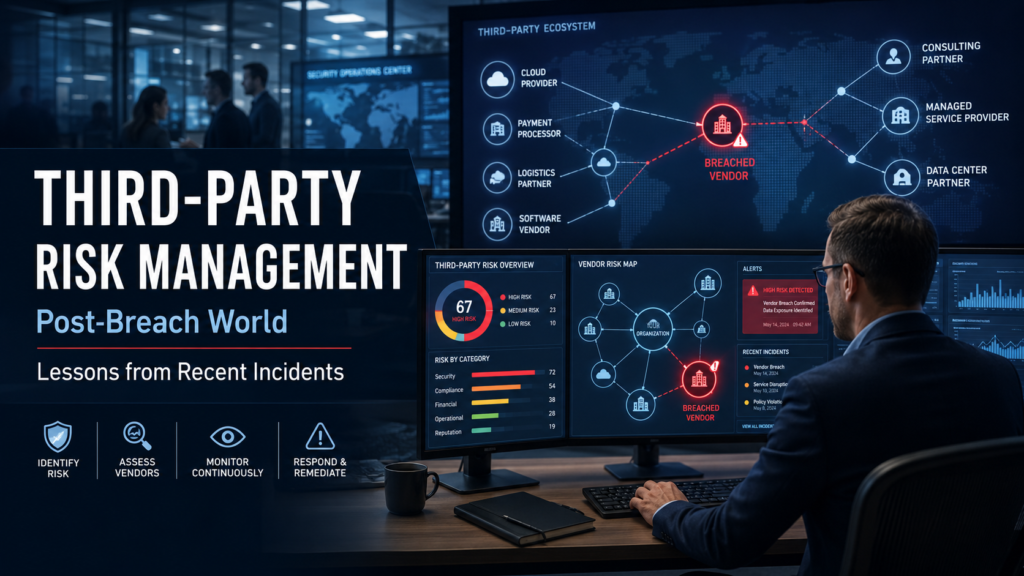
The modern corporate perimeter no longer ends at an organization’s firewall. As digital transformation accelerates, enterprises have woven an intricate web of vendors, cloud service providers, open-source software dependencies, and contractors into their core operations. While this hyper-connectivity drives efficiency and rapid innovation, it simultaneously introduces an expanded threat landscape. Recent historical cyber incidents have proven that an organization’s security posture is only as robust as that of its least secure vendor. In this post-breach reality, traditional security frameworks are falling short, forcing a fundamental shift in how organizations protect their extended ecosystems.
Historically, managing vendor ecosystems relied heavily on static compliance checkmarks. Security teams would send lengthy annual self-attestation questionnaires or look at arbitrary, retrospective risk scores to satisfy regulatory mandates. However, recent cyber events have demonstrated that these point-in-time assessments fail to capture real-time vulnerabilities. When a software vulnerability or a targeted ransomware campaign strikes an external provider, the consequences ripple downstream instantly, long before the next annual review cycle can detect the flaw.
The Cascading Effects of Vendor Ecosystem Failures
The true danger of contemporary supply chain vulnerabilities lies in their “blast radius.” According to cybersecurity research data, the downstream impact of third-party breaches has reached unprecedented heights, with a single vendor compromise often impacting multiple client organizations simultaneously. This phenomenon is known as cascading failure, where an exploit at an upstream provider propagates down through multiple tiers of dependency, hitting organizations that may not even have a direct contractual relationship with the source of the breach.
When a widely used managed service provider, enterprise software utility, or cloud infrastructure tool experiences a compromise, the impact radiates across different industries. The vulnerability becomes a centralized point of failure. Hackers no longer need to breach a dozen heavily fortified enterprise perimeters individually; instead, they target a single, trusted third party that holds administrative access or data-processing privileges for thousands of corporate clients.
This architectural shift in threat actor behavior highlights why treating vendor risk as a siloed compliance exercise is dangerous. Organizations are often blind to their “Nth-party” risk—the vendors of their vendors. If a direct supplier relies on a compromised sub-processor, the final organization in the chain still suffers the data exposure, operational downtime, and regulatory penalties.
Moving Beyond Point-in-Time Compliance
To mitigate these systemic vulnerabilities, security leaders must move away from retrospective assessments. A questionnaire completed six months ago cannot predict a zero-day exploit discovered today, nor can it track an unpatched vulnerability on an external server exposed to the public internet. Furthermore, basic security ratings often lack the critical context required to make business decisions. A generic score does not tell an executive how a specific vendor failure will impact operational continuity, manufacturing output, or regulatory compliance.
Managing risk effectively requires continuous, multi-dimensional intelligence. Organizations need real-time data covering active threat exposures, threat actor targeting patterns, and specific ransomware susceptibility metrics. Relying on a single metric creates a false sense of security. Instead, programs should evaluate external entities based on the specific type of exposure they introduce:
- Technology Providers: Impact system availability, business resilience, and operational continuity.
- Data Processors: Introduce regulatory, privacy, and compliance liabilities if sensitive information is leaked.
- Logistics and Operational Partners: Directly influence physical supply chains, inventory management, and revenue streams.
By categorizing vendors based on asset criticality and data access rather than spending identical resources on every supplier, security teams can optimize their remediation efforts.
The Imperative for Real-Time Supply Chain Visibility
Achieving true ecosystem resilience requires a drastic improvement in third-party risk visibility. Organizations can no longer operate under the assumption that out-of-sight means out-of-mind. Gaining complete, continuous third-party risk visibility across hundreds or thousands of suppliers allows organizations to identify and address security gaps as they emerge rather than discovering them through a breach notification.
When zero-day vulnerabilities are disclosed, enterprises without robust third-party risk visibility spend days or weeks manually contacting vendors to ask if they are affected. This reactive stance leaves a massive window of vulnerability open for exploitation. Conversely, maintaining proactive third-party risk visibility enables security teams to instantly map their vendor inventory against known threat indicators, identifying which external partners share infrastructure or utilize the vulnerable software components. This level of insight allows for collaborative remediation, where an enterprise can actively alert and guide its smaller, less-resourced vendors to patch critical flaws before malicious actors can exploit them.
Moreover, improving visibility helps organizations address concentration risk. Concentration risk occurs when multiple independent vendors all rely on the same underlying cloud infrastructure, database utility, or telecommunications provider. If that foundational provider suffers an outage or a breach, an enterprise might find dozens of its critical applications failing simultaneously. Without comprehensive mapping of these interconnected dependencies, an organization will consistently underestimate its true threat footprint.
What We’ve Learned
The lessons carved out by major supply chain disruptions make one reality clear: third-party risk is an operational business problem, not an administrative check-the-box activity. Waiting for a vendor to issue a breach notification—which industry data shows can take months after the initial compromise occurred—is an architectural flaw in modern risk management.
To survive and thrive in a post-breach world, organizations must evolve their vendor management programs to prioritize automated asset discovery, continuous monitoring, and proactive risk quantification. By integrating comprehensive visibility into the core of supply chain management, organizations can shift from a defensive, reactive posture to an active, resilient defense capable of absorbing external shocks and protecting critical enterprise assets.
Visit this site for Guest Posting and SEO services: izonemedia360.blog
