
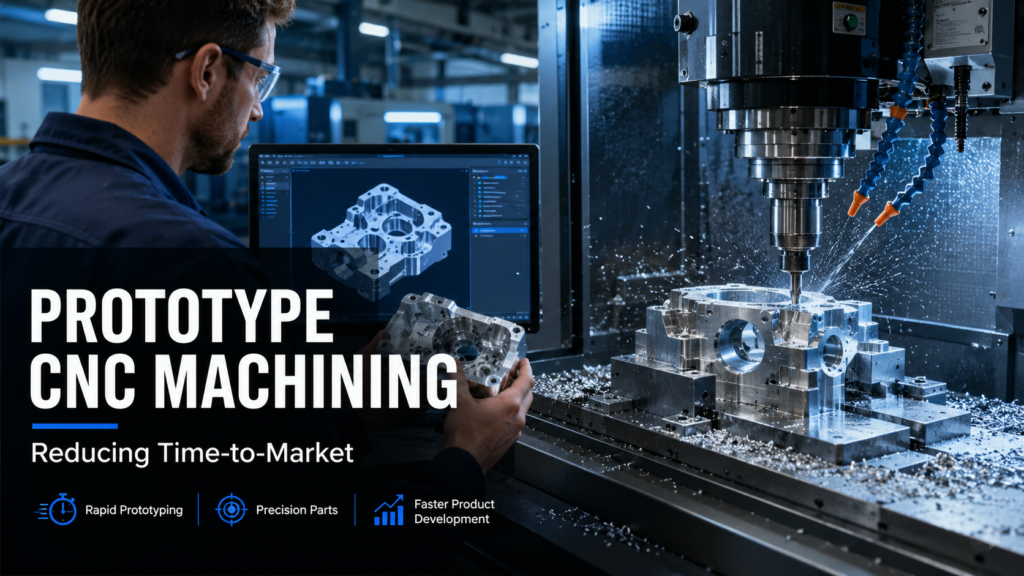
In the hyper-competitive landscape of modern manufacturing, the timeline between a product’s initial conceptualization and its commercial launch is a critical determinant of market success. McKinsey & Company notes that products that hit the market six months late but stay within budget earn roughly 33% less profit over five years than those that launch on time. To avoid these costly delays, engineering teams must rapidly validate designs, conduct mechanical testing, and move into production without facing bottlenecks.
Prototype Computer Numerical Control (CNC) machining has emerged as an indispensable methodology for shrinking these development cycles. Utilizing automated subtractive fabrication, this process allows development teams at manufacturing hubs like Rapid Axis to obtain high-precision, production-grade components within days rather than weeks, fundamentally altering the economics of product validation.
The Role of Rapid Prototyping in Modern Product Development
The core philosophy of modern agile engineering revolves around iterative design: failing fast, learning quickly, and refining constantly. When a design transitions from a computer-aided design (CAD) model to a physical entity, unseen manufacturing or functional challenges frequently arise. Catching these discrepancies during the digital phase is ideal, but physical prototyping is required to assess real-world tactile properties, assembly tolerances, and structural integrity.
Historically, prototyping relied on manual machining or soft tooling, both of which introduced significant lead times and financial overhead. If an engineer discovered a geometric interference after waiting six weeks for an injection-molded prototype tool, the entire process had to reset, adding months to the product launch schedule. Prototype CNC machining eliminates this risk by transitioning directly from digital files to physical parts without requiring intermediate tooling. This seamless workflow enables hardware developers to compress early-stage development, ensuring that functional revisions happen in hours or days rather than months.
Material Realism: Why Machined Prototypes Outperform Additive Alternatives
While 3D printing—or additive manufacturing—is highly effective for basic visual models, it often falls short when rigorous mechanical testing is required. Additive components inherently suffer from anisotropic material properties, meaning their strength varies depending on the axis of layer deposition. This creates structural weak points, making them prone to premature failure under stress, pressure, or thermal load.
In contrast, prototype CNC machining processes utilize solid blocks of production-grade plastics and metals, ensuring isotropic material properties identical to final production units. This material realism is vital across demanding sectors like aerospace, defense, and medical devices. Common materials include:
- Aluminum alloys (e.g., 6061-T6): Known for an excellent strength-to-weight ratio, structural integrity, and exceptional thermal conductivity.
- Stainless steel (e.g., 304 or 316L): Highly valued for its corrosion resistance, toughness, and ability to withstand cleanroom sterilization processes.
- Engineering thermoplastics (e.g., PEEK and Delrin): Utilized for high-wear components, low moisture absorption, and excellent electrical insulation.
- Specialty composites (e.g., G-10/FR-4): Selected for high-pressure fiberglass laminates requiring superior dielectric strength.
By using identical materials to those specified for the final product, engineers can confidently subject prototypes to aggressive environmental and mechanical exposure, gathering accurate empirical data that directly reflects end-use performance.
Eliminating Tooling Constraints to Accelerate Design Iterations
One of the biggest obstacles to a faster product launch is the costly and time-consuming process of producing hard tooling, such as steel molds for injection molding or dies for metal stamping. Tooling can take several weeks to design, manufacture, and validate. When a design flaw is discovered during first-article inspection, modifying a hardened steel tool can be both expensive and technically challenging.
Because CNC machining is software-driven, it allows manufacturers to revise components without rebuilding physical tooling. Through its rapid prototyping capabilities, Rapid Axis can implement design changes by updating the 3D CAD model, modifying the toolpaths in computer-aided manufacturing software, and machining a new piece from raw material.
Advanced four-axis and five-axis CNC systems further accelerate this process by allowing the cutting tool or workpiece to rotate dynamically. This makes it possible to produce intricate geometries, deep pockets, and complex organic shapes in fewer setups, reducing manual handling, setup delays, and the potential for human error.
Streamlining Functional Testing and Quality Assurance
A product cannot safely or successfully enter the commercial market without passing a batteries of quality assurance and regulatory checks. Whether validating fluid dynamics in a manifold, pressure containment in a valve, or mechanical stress in a robotic arm, prototypes must be tested to the point of failure.
Because prototype CNC machining delivers components held to extremely tight tolerances—frequently down to ±0.002 inches or tighter—these parts behave predictably within complex mechanical assemblies. Engineers can execute precise form, fit, and function analyses to guarantee smooth interfaces between moving components. Furthermore, having access to precise first-article prototypes allows manufacturing facilities to establish accurate Coordinate Measuring Machine (CMM) inspection data early in the process. Catching dimensional anomalies or structural discrepancies during this prototype phase prevents catastrophic failures further down the supply chain, ensuring that when full production begins, the manufacturing yields remain consistently high.
Bridging the Gap from Prototype to Small-Batch Production
The transition from a final prototype to a scaled manufacturing run is rarely instantaneous. Supply chain alignment, assembly line optimization, and regulatory approvals often create a transitional gap. Prototype CNC machining functions as an ideal bridge production mechanism during this critical phase.
Because CNC machining parameters are highly scalable, the exact same digital architecture used to create a single proof-of-concept part can be deployed to manufacture tens, hundreds, or even thousands of units. This flexibility allows companies to launch pilot programs, supply early-stage customer testing, or fulfill initial market demands while waiting for permanent high-volume tooling to be completed. By mitigating the traditional “all-or-nothing” approach to production sourcing, companies can maintain continuous market momentum, gathering invaluable real-world consumer feedback while minimizing upfront financial risks.
Final Analysis
Reducing time-to-market is not merely about working faster; it is about working more intelligently by removing systemic friction from the product development lifecycle. Prototype CNC machining achieves this by bypassing the long lead times of custom tooling, offering unmatched material authenticity, and supporting seamless design flexibility. By collaborating with sophisticated manufacturing partners like Rapid Axis, engineering teams can quickly turn digital iterations into production-ready physical components. In an era where market first-movers capture the majority of industry value, leveraging high-precision machined prototypes remains one of the most effective strategies for transforming innovative ideas into commercial realities safely, efficiently, and predictably.
Visit this site for Guest Posting and SEO services: izonemedia360.blog
