
Active Directory sits at the center of almost every enterprise network. It decides who can log in, what they can touch, and which systems trust them. That central role is exactly why it has become such a popular target: research from IBM’s X-Force threat intelligence team found that a large majority of enterprise cyberattacks rely on Active Directory to escalate privileges and move sideways through a network once attackers get a foothold. Despite this, many organizations still treat Active Directory as a “set it and forget it” system rather than something that needs continuous oversight.
This is where auditing comes in. Active directory auditing guidelines exist precisely because AD environments drift over time, permissions accumulate, old accounts linger, and small misconfigurations pile up until they become real attack paths. Understanding why auditing matters, and why it’s so often neglected, is the first step toward closing that gap.
The Real Cost of Not Watching Your Directory
It’s easy to assume that firewalls, endpoint protection, and multi-factor authentication are enough to keep a network safe. But those controls don’t tell you what’s actually happening inside Active Directory itself, who was added to a privileged group last week, whether a service account suddenly gained new rights, or if a disabled user was quietly re-enabled.
Industry data backs up the risk. One analysis of enterprise AD assessments found that mismanagement of Active Directory left the large majority of businesses exposed to breaches, often because administrators were unaware of how permissions had changed over time. Separate research on AD security posture attributed roughly a quarter of data breaches to improper permission settings or unauthorized permission changes that went unnoticed. These aren’t exotic attack techniques, they’re ordinary configuration drift that nobody was watching.
When a breach does happen, the fallout is significant. Reports on the cost of AD-related incidents have put average breach expenses well into seven figures, with recovery and business disruption often stretching on for days or weeks. That’s a steep price for something that regular auditing could have flagged early.
What Active Directory Auditing Guidelines Typically Cover
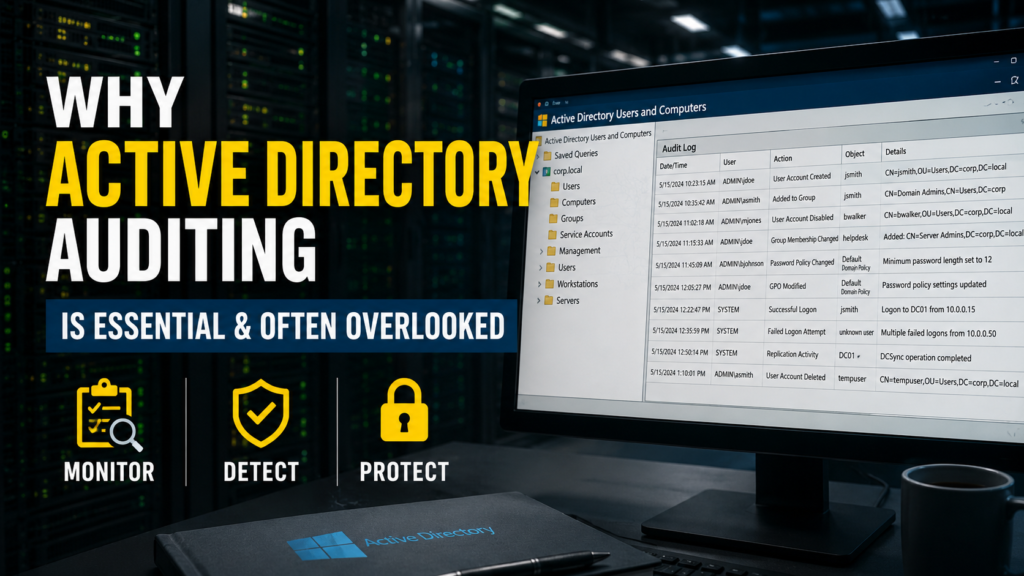
Most active directory auditing guidelines focus on a consistent set of areas, regardless of the specific tools an organization uses. These guidelines generally recommend tracking:
- Privileged group membership changes — additions or removals from groups like Domain Admins, Enterprise Admins, or any group with elevated rights
- Account creation, deletion, and status changes — especially reactivation of previously disabled accounts
- Password and authentication policy changes — including modifications to expiration rules or lockout thresholds
- Group Policy Object (GPO) modifications — since GPOs can silently alter security settings across an entire domain
- Permission and access control list (ACL) changes — particularly on sensitive organizational units or objects
- Failed and unusual logon attempts — patterns that may indicate password spraying or brute-force activity
- Replication and domain controller activity — to catch techniques like DCSync or DCShadow that mimic legitimate domain controller behavior
Covering this list isn’t a one-time project. It requires ongoing log collection, retention policies that meet compliance requirements, and a process for actually reviewing what’s collected rather than letting it sit unread in a SIEM.
Why Auditing Gets Deprioritized
If auditing is so clearly valuable, why do so many IT teams still under-invest in it? A few recurring reasons come up across security assessments and industry surveys.
First, Active Directory’s native auditing tools generate an enormous volume of events, and sorting signal from noise takes real effort. Many teams don’t have the staffing to build meaningful alerting on top of raw event logs, so audit data becomes something that’s collected but rarely reviewed.
Second, AD is often seen as “legacy” infrastructure, stable, familiar, and unglamorous compared to newer cloud identity platforms. That perception leads to underinvestment even as hybrid identity setups, which connect on-premises AD to cloud directories, introduce new complexity. Research on AD attack patterns has found that a substantial share of attacks specifically target these hybrid configurations, where gaps between on-site and cloud systems create blind spots.
Third, there’s a general assumption that “nothing has changed, so nothing needs checking.” This is precisely the mindset that active directory auditing guidelines are meant to counter. Environments change constantly, new employees, departing employees, contractors, service accounts, application integrations, and each change is a potential opportunity for a misconfiguration to slip through unnoticed.
Building a Sustainable Auditing Practice
Organizations that manage to keep auditing on track tend to treat it as a recurring operational habit rather than a periodic compliance checkbox. That typically means assigning clear ownership for reviewing privileged access on a set schedule, rather than leaving it to whoever notices a problem first. It also means correlating AD logs with other security data, since an unusual permission change combined with an odd login pattern is far more telling than either signal on its own.
Regularly reviewing stale and inactive accounts is another practical habit. Former employees who retain access long after departure are a well-documented risk factor, and simply disabling or removing those accounts on a routine basis closes off an easy path for attackers. Similarly, auditing service accounts — which often carry excessive permissions and passwords that never expire — helps limit the damage if one is ever compromised.
None of this requires exotic tooling. What it requires is consistency: applying the same active directory auditing guidelines every month, not just after an incident or before a compliance deadline.
What We’ve Learned
Active Directory auditing isn’t a glamorous part of IT operations, but it’s one of the more consequential ones. The data is consistent across multiple independent studies: unmonitored permission changes, stale accounts, and privileged access sprawl are recurring contributors to real-world breaches, and they’re exactly the kinds of issues that structured auditing is designed to catch early.
The organizations that avoid becoming statistics aren’t necessarily the ones with the most advanced security stack — they’re often the ones that treat auditing as routine maintenance rather than an afterthought. Following established Active Directory auditing guidelines consistently, reviewing what those audits reveal, and acting on the findings is a far less costly habit than dealing with the aftermath of a compromise that better visibility could have prevented.
Visit this site for Guest Posting and SEO services: izonemedia360.blog
