
Introduction
A Business Management System is a framework that helps businesses improve their operations, maintain compliance, and manage processes efficiently. Organizations of all sizes can benefit from adopting a system that integrates strategic planning, document management, performance metrics, and workflow optimization. By combining data, analytics, and automation, a Business Management System allows leaders to make better decisions while improving employee productivity, fostering cross-functional collaboration, and promoting organizational excellence.
This guide will explore every aspect of a Business Management System, from its definition and components to its benefits, limitations, and future trends.
Business Management System – Complete Introduction
A Business Management System is a structured framework designed to support business operations by coordinating processes, projects, and resources. It allows companies to maintain continuous improvement in their operations while tracking performance and aligning actions with strategic goals. A Business Management System integrates cross-functional teams, supports stakeholder trust, and enhances the visibility of business activities. In practice, it serves as a centralized platform where document management, workflow mapping, and automation tools come together to improve overall efficiency and decision-making. Companies that adopt a Business Management System can maintain standard operating procedures, measure benchmarks, and achieve organizational excellence.
Meaning and real-world relevance
The real-world value of a Business Management System lies in its ability to combine processes, data, and strategic planning into a coherent structure. It allows organizations to track tasks, manage projects, and analyze performance metrics in real-time. Businesses can monitor compliance, reduce errors, and create a framework for continuous improvement. For employees, a well-implemented system provides clarity in roles, responsibilities, and workflow while fostering collaboration across teams. For organizations, it ensures operational efficiency, resource optimization, and enhanced decision-making through analytics and reporting dashboards.
What Is a Business Management System?
A Business Management System is a collection of tools, software, policies, and processes designed to manage and optimize every aspect of a business. It is not just software; it is a framework that aligns strategic goals with day-to-day operations. A Business Management System incorporates document management, project tracking, risk mitigation, and performance measurement to provide a clear view of an organization’s goals and achievements. It improves workflow efficiency, supports employee training, and integrates cloud-based solutions to allow teams to access data securely from any location.
Simple definition for modern businesses
In practical terms, a Business Management System is a central hub for monitoring and controlling operations. It includes document repositories, dashboards for real-time insights, analytics tools to track progress, and automation to reduce human error. Modern businesses use these systems to improve cross-functional collaboration, align policies with standards, and implement continuous improvement initiatives that enhance overall performance.
Business Management System vs Business Management Software
Although the terms are sometimes used interchangeably, a Business Management System and business management software serve different purposes. A Business Management System refers to the framework that organizes processes, guidelines, and strategic planning, while business management software is the technology tool that supports the system.
Key conceptual and functional differences
| Feature | Business Management System | Business Management Software |
| Scope | Organizational processes and standards | Specific software functions like CRM, accounting, or HR |
| Focus | Strategy, workflow mapping, risk mitigation | Task management, reporting, and automation |
| Integration | Combines processes, document management, dashboards, and analytics | May function independently or integrate partially |
| Example | ISO-based frameworks, corporate compliance systems | Salesforce, SAP, Oracle, or project management tools |
Why Businesses Need a Business Management System Today
As businesses grow, the complexity of operations increases. Large enterprises face challenges in project coordination, resource allocation, and compliance tracking. A Business Management System provides a centralized structure that simplifies these challenges. It supports strategic planning, improves decision-making, and ensures data integrity across departments. Companies that implement a BMS see significant improvements in operational efficiency, employee productivity, and stakeholder trust. Studies show organizations adopting structured management systems achieve a 20-30% improvement in efficiency.
Problems it solves in growing organizations
A Business Management System helps manage complex hierarchies, reduces errors, and provides visibility into cross-functional operations. It prevents misalignment between departments, improves documentation, and allows organizations to track compliance and risk management activities effectively.
Core Components of a Business Management System
A Business Management System is built on several key components that collectively improve efficiency, accountability, and strategic performance.
Process and workflow management
This component defines and structures business processes, ensuring that every task, project, and operation is mapped, tracked, and optimized. It allows companies to adapt processes to changing goals, monitor performance metrics, and implement automation to reduce errors and increase productivity.
Document and knowledge management
Documentation is central to a Business Management System. A centralized repository ensures all policies, guidelines, and standard operating procedures are accessible and secure. Features like version control, audit trails, and cloud-based storage reduce errors and improve stakeholder trust.
Performance measurement and dashboards
A Business Management System uses dashboards to provide real-time insights into operational performance, task completion, and process efficiency. These visualizations help managers track benchmarks, identify gaps, and implement continuous improvement strategies.
Compliance, risk, and quality control
Compliance monitoring ensures operations meet standards and legal requirements. A Business Management System integrates risk mitigation tools, security protocols, and quality frameworks to maintain operational excellence and protect the organization from potential disruptions.
Explore how Warranty Management Software streamlines operations, reduces errors, and boosts efficiency across all business processes.
Role of Process-Based and Graphical Business Management Systems
Graphical systems improve understanding by visualizing workflows and process dependencies. They allow employees to follow standard operating procedures, simplify training, and enhance audit readiness. Using visual tools for mapping processes increases efficiency, reduces errors, and promotes continuous improvement.
Visual workflows and decision clarity
Graphical representations help managers see how tasks connect, which departments rely on which processes, and where bottlenecks exist. This visibility improves strategic planning and enables better resource allocation.
How a Business Management System Improves Decision-Making
By centralizing data, a Business Management System provides managers with accurate analytics to make informed decisions. The system tracks goals, progress, and employee performance, giving strategic visibility into all operations. Real-time dashboards help businesses adjust processes quickly and support continuous improvement initiatives.
Data alignment and strategic visibility
All business data, from project tracking to financial metrics, is integrated in a Business Management System. This allows teams to collaborate, monitor performance benchmarks, and align operations with strategic goals.
Key Benefits of Using a Business Management System
A Business Management System offers measurable advantages that improve efficiency, reduce errors, and strengthen organizational processes.
Operational efficiency and cost control
Organizations experience reduced redundancies, faster task completion, and better resource utilization. Automation and integrated software tools allow businesses to track performance, lower operational costs, and reduce errors.
Automation and error reduction
A Business Management System uses automated processes for document management, task tracking, and project updates. This reduces human error, improves accuracy, and frees employees to focus on strategic tasks.
Transparency and accountability
Centralized data provides visibility to all stakeholders, enabling accountability across teams and promoting trust within the organization.
Common Business Functions Managed Through a BMS
A Business Management System handles essential business operations, integrating multiple functions into one framework.
Project and task coordination
All projects and tasks are assigned, tracked, and monitored in real time. Managers can follow progress, adjust resources, and ensure timely delivery.
Finance and accounting control
Accounting tasks such as invoicing, budgeting, and payroll are automated. This reduces errors, improves compliance, and allows executives to view financial dashboards in real time.
HR and team performance tracking
HR functions such as employee onboarding, performance reviews, and time tracking are managed within the system, enabling better employee training and team collaboration.
CRM and customer processes
A Business Management System centralizes customer data, sales tracking, and relationship management. Teams can monitor customer interactions, analyze performance metrics, and improve service quality.
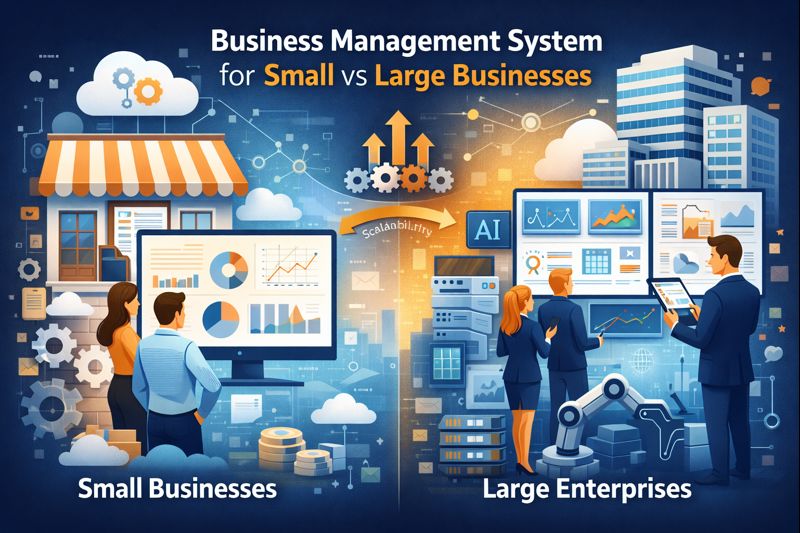
Business Management System for Small vs Large Businesses
A Business Management System adapts to business size and complexity. Small businesses benefit from cloud-based solutions that are lightweight and easy to use, while large enterprises need scalable systems that support cross-functional teams, integration, and data analytics for strategic decision-making.
Scalability and adaptability considerations
Scalability allows businesses to add modules, users, or processes without disrupting operations. Adaptable systems ensure workflow optimization, risk mitigation, and continuous improvement across all departments.
Limitations and Flaws in Business Management Systems
No system is perfect. Large organizations sometimes struggle with overly complex BMS implementations. Challenges include long adoption times, resistance from employees, and difficulty in integrating legacy systems. Some systems are not user-friendly, which can reduce compliance and lower productivity.
Where businesses struggle most
Common problems include difficulty in mapping processes, poor documentation, inadequate training, and lack of real-time dashboards. Without proper implementation, a BMS can fail to improve efficiency or reduce errors.
How to Make a Business Management System More Effective
Effectiveness depends on customization, employee engagement, and continuous monitoring. Organizations should regularly review workflows, improve document management, and update standards to reflect current goals.
Customization and continuous improvement
Customizing dashboards, analytics tools, and automation processes ensures the system fits the organization’s needs. Regular review of metrics and performance keeps the system relevant and effective.
How to Choose the Right Business Management System
Choosing the right Business Management System requires evaluating business needs, software capabilities, and scalability.
Business needs assessment
Organizations should assess current workflow, task tracking, and process optimization gaps before selecting a system. Understanding stakeholder requirements is also essential.
Feature evaluation and scalability
Evaluate software tools, dashboards, automation, and cloud-based integration. Ensure the system can expand with growth and handle cross-functional teams efficiently.
Implementation Roadmap for a Business Management System
A structured implementation plan reduces disruptions. Start with a pilot program, then deploy system-wide after testing. Monitor progress, data accuracy, and employee adoption to support continuous improvement.
Planning, adoption, and optimization
Include training programs, policy guidelines, and review checkpoints. Optimize workflow, document management, and performance tracking during the first few months to ensure operational excellence.
Common Mistakes Businesses Make with BMS
Many organizations make errors such as choosing overly complex systems, failing to train employees, or not aligning the system with strategic goals. These mistakes lead to inefficiency, low employee adoption, and increased errors.
Strategic and operational errors to avoid
Avoid selecting software without considering process integration, neglecting document management, and ignoring dashboards for real-time insights. Poor planning and lack of review can hinder productivity and organizational excellence.
Future Trends in Business Management Systems
The next generation of Business Management Systems will focus on automation, advanced analytics, cloud-based solutions, and real-time performance dashboards. Organizations are adopting AI-powered analytics and visualization tools to improve strategic planning and operational efficiency.
Automation, analytics, and integration
Automation reduces manual errors, analytics provide insights for risk mitigation, and integration ensures data consistency across departments. Future systems will combine project management, document tracking, and employee performance monitoring in a single framework.
Learn why Accounting Software for Multiple Businesses is key for scaling operations, managing finances, and making smart strategic decisions.
Frequently Asked Questions (FAQs)
What is a Business Management System?
A Business Management System is a structured framework that helps organizations manage their processes, documents, projects, and operations efficiently. It allows companies to track performance, maintain compliance, and improve workflow across all departments.
How does a Business Management System differ from software?
While business management software is a tool that helps automate specific tasks, a Business Management System is the overall framework that organizes processes, strategies, and policies. Software supports the system, but the system ensures organizational excellence.
Why do businesses need a Business Management System?
Businesses, especially large organizations, need a Business Management System to reduce errors, improve efficiency, track performance metrics, and maintain compliance. It also helps align strategic goals with day-to-day operations.
What are the key components of a Business Management System?
The main components include process and workflow management, document and knowledge management, performance dashboards, risk and compliance control, and quality management. These elements together improve productivity, data visibility, and decision-making.
How does a Business Management System improve decision-making?
By integrating real-time data, performance dashboards, and analytics, a Business Management System allows managers to monitor tasks, track benchmarks, and make informed strategic decisions that support continuous improvement.
Can a small business benefit from a Business Management System?
Yes, small businesses can use cloud-based Business Management Systems to manage projects, documents, team performance, and customer relationships efficiently. Scalable solutions allow smaller teams to grow without losing control over operations.
What is the role of graphical Business Management Systems?
Graphical or visual Business Management Systems use flowcharts, diagrams, and maps to display processes clearly. They help teams understand workflows, track tasks, reduce errors, and enhance training for employees.
How does automation work in a Business Management System?
Automation in a Business Management System reduces manual work by handling task tracking, document updates, and data entry automatically. This increases efficiency, lowers errors, and allows employees to focus on strategic tasks.
What is the importance of compliance in a Business Management System?
A Business Management System helps maintain compliance with standards, regulations, and company policies. It reduces the risk of legal issues, improves stakeholder trust, and ensures that operations meet quality standards.
How do performance dashboards help businesses?
Performance dashboards provide real-time insights into tasks, projects, employee productivity, and operational efficiency. They help managers identify bottlenecks, monitor KPIs, and plan strategic improvements effectively.
Can a Business Management System reduce errors?
Yes, by integrating automation, document management, and workflow optimization, a Business Management System significantly reduces manual errors, improves data accuracy, and enhances task reliability across teams.
How does a Business Management System support cross-functional teams?
A Business Management System promotes collaboration between different departments by centralizing data, documents, and project tracking. This ensures that teams work in sync, share insights, and achieve strategic goals efficiently.
What should a business consider before choosing a Business Management System?
Businesses should assess their workflow needs, processes, compliance requirements, employee capacity, and future growth plans. They should also evaluate software tools, dashboards, and cloud-based integration for scalability.
What are common mistakes businesses make with a Business Management System?
Common mistakes include choosing overly complex systems, neglecting employee training, failing to document processes, and not aligning the system with strategic objectives. These mistakes can reduce efficiency and hinder continuous improvement.
What are future trends in Business Management Systems?
Future trends include automation of workflows, advanced data analytics, cloud-based integration, graphical dashboards, and real-time performance monitoring. These trends help organizations scale, maintain operational excellence, and improve strategic decision-making.
Final Thoughts: Building a Smarter Business with a Management System
A Business Management System supports organizational growth by improving processes, workflow efficiency, and decision-making. It fosters employee productivity, enhances stakeholder trust, and integrates strategic planning with operational excellence. Proper selection, implementation, and continuous monitoring ensure a system that grows with the organization, supporting long-term success.
Disclaimer:
“The information in this article is for educational purposes only. It does not constitute professional, financial, or legal advice. Readers should evaluate their business needs carefully and seek expert guidance before implementing any Business Management System.”
