
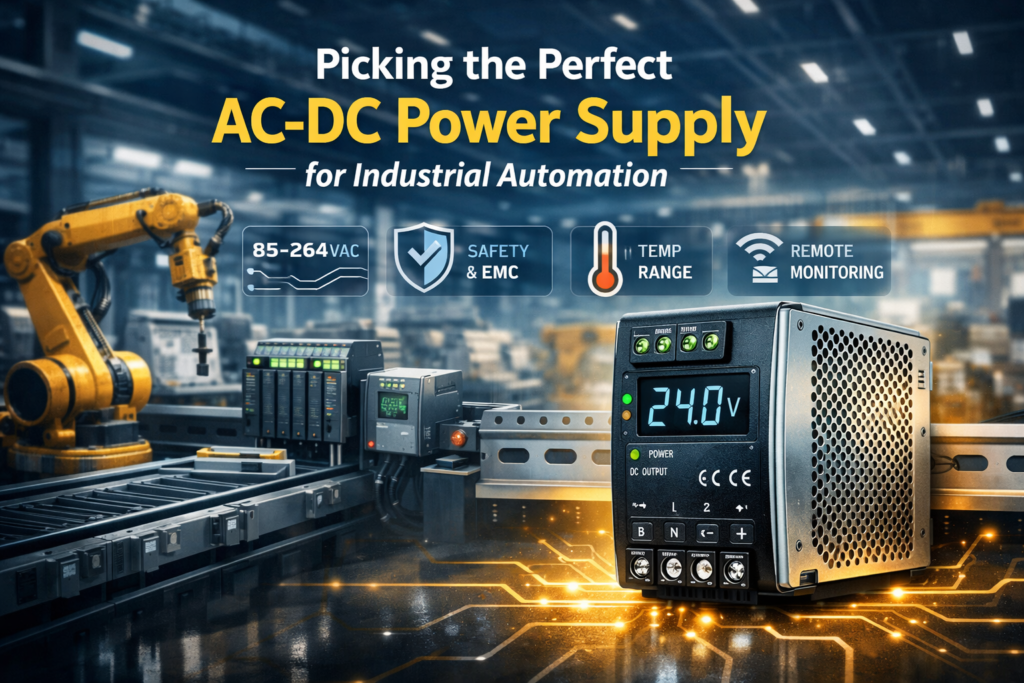
Industrial automation systems are the backbone of modern manufacturing. Power supplies are one of the most critical, but often overlooked, components that systems are built on. Selecting the wrong unit could result in costly downtime, erratic machine behavior, and safety hazards. This guide walks you through the process of choosing the right automation system AC-DC Power Supply for your purposes https://www.omch.com/ru/ac-dc-power-supply/.
Recognizing Core Input Specifications
The most important variable at the start of the journey is the electrical systems at your facility. Note that a power supply must work with the AC mains voltage and the frequency.
- Input Voltage Range: Because of the nature of Industrial settings, there could be extreme fluctuations in the voltage levels. If a unit is voltage rated for a single voltage, for example, 230VAC, that unit is going to fail because of the brown-out conditions. Therefore, it’s best to find a unit with a wider input, such as the 85-264 VAC. This means the same power supply is able to work globally and also survive without interruption, even in the case of line sags.
- Input Frequency: This might be important in older and specialized equipment.
- Inrush Current Limiting: During the initial phase of powering up a device, the current necessary for charging the internal capacitors can reach values 10-100 times the steady-state current. This can damage input components or trip the circuit breakers. Good quality industrial power supplies have active inrush current limiting, thus avoiding this phenomenon.
- Hold-up Time: This is the time a power supply can keep regulating its output, even with the AC input lost. 20ms is a common specification for a power supply, and is sufficient for short breaks, or for enabling a system to be powered down in a controlled way.
Defining Your Output Requirements
Defining the requirements of your load is the most important action you can take. Under-specifying is bound to lead to failure, while over-specifying leads to poorly utilized capital and space.
- Output Voltage and Current: Determine the total current requirements of all the devices attached to the system at their nominal voltage. Ensure to account for additional current requirements due to peak loads and future expansions (100% to 130% of nominal current is a commonly used range for this). If your system has several voltage levels, you may need a power supply with multiple outputs, or several power supplies with a single output.
- Constant Voltage (CV) vs. Constant Current (CC): Most automation devices (PLCs, sensors, drives) need a steady supply that is CV. CC supplies are for specialized applications like battery charging or LED driving. Ensure your choice matches the load characteristic.
- Ripple and Noise: Small amounts of undesired AC superimposed on the DC output are called ripple and noise. Increased noise can affect analog sensors and communication equipment. Industrial-grade supplies are built with lower noise and ripple levels, typically in the low millivolt range.
- Dynamic Response: How fast can the supply adjust to a sudden step change in the load current? Insufficient response can lead to output voltage undershoot or overshoot, resetting the controllers. For important and fast-switching loads, examine the transient response specification.
Surviving in harsh environments is the norm for industrial-grade power supplies.
- Operating Temperature: In many factories, the heat is on. That is where derating, or the reduction of maximum output power, comes into play. Power supplies that can operate at full load at 50 degrees Celsius are much more robust than their counterparts, which must be derated by 50% at the same temperature. Make sure your unit’s rating exceeds your ambient temperature.
- Enclosure and Cooling: Will the supply fit in a sealed cabinet? Forced air cooling (with a fan) offers higher cooling density, but the fan creates a moving part and possible failure and impaction. Convection cooling (fanless) is better in dusty and oily environments, though fosters higher enclosure air volume.
- Ingress Protection (IP) Rating: If the supply is exposed to dust, moisture, or washdown, an appropriate IP rating (IP65 for dust-tight and water jet protection) is a must.
- Form Factor and Mounting: Industry standard for panel building is DIN rail mounting (like TS-35/15), which allows for quick and easy mounting and demounting. Pay attention to the physical sizeofr your enclosure design.
Safety, Compliance, and Reliability
Regulatory compliance is not optional; it is necessary to protect the personnel and equipment.
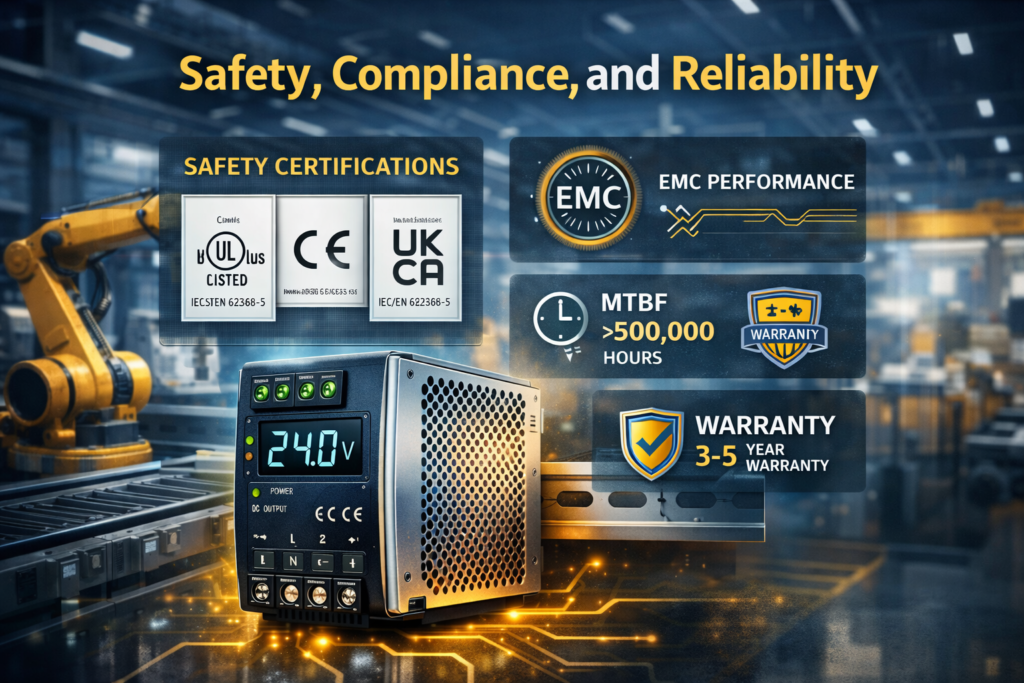
- Safety Certifications: Look for mandatory marks like UL/IEC/EN 62368-1 (which is the most current safety standard for IT/AV equipment), along with the appropriate local marks (cULus, CE, UKCA). These marks protect as they ensure the design complies with the rigorous relevant requirements for electrical isolation, creepage, and clearance.
EMC Performance: Electromagnetic Compatibility (EMC) is another critical area of concern. The EM-FO-24-200-NAF-EMC series should be compliant with emission standards (EN 55032/Class A or B) so as not to pollute the line, and immunity standards (EN 61000-4 series) to survive surges, ESD, and fast transients, without damage. A supply that causes EMC issues can cripple an entire production line.
Mean Time Between Failures (MTBF): While admittedly a theoretical metric, MTBF >500,000 hours is quite impressive and offers a good basis for comparison for different suppliers. It indicates a good level of design and quality of components used, and more importantly, good derating used for the design.
Warranty: Manufacturer warranty periods provide a good indication of the expected reliability of the product. 3-5 years is a fair expectation for an industrial component.
Additional Features and Suppliers
In addition to the core specs, features that enhance system intelligence and ease of integration are becoming commonplace.
Remote On/Off & Power Good Signal: These remote control and monitoring features provide the system controller the ability to sequence power or to be notified if the supply has failed.
Communication Capabilities: Modern supplies provide digital communication protocols (PMBus, CANopen, MODBUS) to monitor critical parameters (voltage, current, temperature, status) to enable predictive maintenance.
- Redundancy Support: With mission-critical apps, some components can be ported in parallel with OR-ing diodes or active current-sharing circuits for N+1 redundancy configuration, guaranteeing zero downtime loss for single unit failures.
- Choosing a Trusted Partner: Ultimately, your supplier selection is as critical as the technical specifications. You want to prioritize manufacturers with established reputations in industrial automation, solid technical support, and a global footprint. For engineers, the specific supplier’s portfolio is a valuable resource for reliable solutions, e.g., the industrial AC-DC power supplies at OMCH offer contextual features and specifications.
Consideration and time put into selecting the right AC-DC power supply can be seen as investing in the system’s automation longevity and stability. By examining and properly evaluating the system’s input requirements, output demands, surrounding variables, safety standards, and other additional features, you truly will have a solid power foundation for your system to continue running your production lines seamlessly for countless years to come.
“Discover the latest innovations with BeaconSoft, exploring game-changing tech trends that are reshaping industries and driving the future of digital solutions.”
Frequently Asked Questions (FAQs)
What is an AC-DC power supply in industrial automation?
An AC-DC power supply converts AC electricity from the main power line into stable DC power that machines, PLCs, sensors, and controllers can use. In industrial automation, it keeps systems running smoothly by delivering clean and reliable power.
Why is choosing the right AC-DC power supply important?
If you choose the wrong power supply, you may face machine breakdowns, unexpected downtime, unstable performance, or even safety risks. The right unit protects your equipment and keeps production running without interruptions.
How do I calculate the correct output current for my system?
First, add the current requirements of all connected devices at their rated voltage. Then add a safety margin of about 20% to 30% for peak loads and future expansion. This helps prevent overload and improves long-term reliability.
What input voltage range should I look for?
In industrial environments, voltage levels often fluctuate. A wide input range, like 85–264 VA, is ideal because it handles voltage drops and works in different countries without problems.
What is hold-up time, and why does it matter?
Hold-up time is the duration a power supply can maintain its output after the input power is lost. A typical 20ms hold-up time helps protect equipment from short power interruptions and prevents sudden shutdowns.
What is inrush current, and how can it affect my system?
Inrush current is the high current drawn when the power supply is first turned on. If not controlled, it can trip circuit breakers or damage components. Industrial-grade power supplies include inrush current limiting to prevent this issue.
Should I choose constant voltage (CV) or constant current (CC)?
Most automation devices like PLCs and sensors require constant voltage (CV). Constant current (CC) is mainly used for special applications like battery charging or LED drivers. Always match the power supply type to your load.
What is ripple and noise in a DC power supply?
Ripple and noise are small,l unwanted voltage fluctuations on the DC output. High ripple can disturb sensitive equipment like analog sensors or communication systems. Industrial power supplies are designed to keep ripple very low.
How does temperature affect power supply performance?
High temperatures reduce a power supply’s performance. Many units require derating at higher temperatures. Choose a power supply that can operate at full load at 50°C or higher if your environment is hot.
What cooling method is better: fan or fanless?
Fan-cooled units offer higher power in smaller sizes but have moving parts that can fail. Fanless (convection-cooled) models are better in dusty or oily environments because they require less maintenance.
What is an IP rating, and when is it needed?
IP (Ingress Protection) rating shows how well a device is protected from dust and water. For harsh industrial areas, ratings like IP65 are recommended to prevent damage from dust or washdowns.
Why are safety certifications important?
Certifications like UL, CE, and IEC standards confirm that the power supply meets safety and isolation requirements. Using certified products protects workers and equipment and ensures compliance with regulations.
What is EMC compliance, and why should I care?
EMC (Electromagnetic Compatibility) ensures the power supply does not interfere with other equipment and can resist electrical disturbances like surges or static discharge. Poor EMC performance can disrupt an entire production line.
What does MTBF mean in power supplies?
MTBF (Mean Time Between Failures) estimates the expected reliability of a power supply. A higher MTBF, such as 500,000 hours or more, usually indicates better design quality and longer service life.
Are modern AC-DC power supplies smart?
Yes, many modern industrial power supplies include features like remote on/off control, power good signals, and communication protocols such as MODBUS or CANopen. These features allow monitoring, predictive maintenance, and better system control.
Conclusion
Choosing the right AC-DC power supply is essential for safe, stable, and efficient industrial automation. By carefully checking input range, output needs, safety standards, and environmental factors, you can ensure long-term reliability and smooth system performance.
Disclaimer:
“This article is for educational and informational purposes only. It does not replace professional engineering advice or official safety guidance. Readers should verify specifications, standards, and compliance requirements before making any technical decisions.”