
Managing the finances of multiple businesses requires more than just basic bookkeeping. Companies often struggle to consolidate data, track expenses, and gain real-time insights across all entities. Accounting software for multiple businesses provides a centralized system where each company’s financial information is organized, and reporting is simplified. From invoicing to tax filing, AP automation to intercompany transactions, such software allows businesses to control their cash flow, manage accounts payable, and maintain GAAP-compliant financial records efficiently.
This guide explains how multi-entity accounting software works, what features it should include, which tools are most effective, and how businesses can manage their finances across multiple entities without errors.
What Is Accounting Software for Multiple Businesses?
Accounting software for multiple businesses is designed to manage finances for companies that have more than one entity. Each entity can have its own income, expenses, invoices, and reporting needs, yet all the financial data is centralized for easier visibility and decision-making. Such software allows companies to handle intercompany transactions, maintain balance sheets for individual entities, and consolidate reports across the organization. Modern systems are usually cloud-based, supporting multiple currencies, global payments, and secure bank reconciliation. By using this software, businesses can see a complete overview of finances at the enterprise level while still maintaining control at the individual entity level.
How Accounting Software for Multiple Businesses Works?
The operation of multi-entity accounting software relies on centralized systems that connect the financial activities of all entities in one platform. Each business entity can have its own chart of accounts, income statements, and expense tracking tools, while the software consolidates this information for reporting. Automation features like recurring invoices, OCR scanning for invoices, and approval workflows help reduce manual work and minimize errors. AP automation and ERP system integration allow companies to handle supplier onboarding, process payments efficiently, and maintain a full audit trail. Companies using such software can generate consolidated reports, track project performance, and gain real-time insights into their cash flow, helping finance teams manage multiple operations without missing critical details.
Why Managing Multiple Businesses Needs Specialized Accounting Software?
Handling multiple businesses using traditional accounting methods often leads to inefficiencies and errors. Without specialized software, companies struggle with manual consolidation, inconsistent tax filing, and incorrect financial reporting. Centralized accounting software provides clarity by ensuring that income, expenses, and accounts payable are tracked individually for each entity while still providing enterprise-level visibility. It also supports multi-currency operations, enabling global companies to manage payments and maintain compliance across borders. Businesses benefit from accurate bank reconciliations, proper expense categorization, and streamlined project accounting, helping managers make informed financial decisions for all entities.
Core Features Required in Accounting Software for Multiple Businesses
When selecting accounting software for multiple businesses, there are certain core features that are essential for efficiency, accuracy, and control. These features ensure smooth financial management and reduce manual work across all entities.
Invoicing and Billing Across Multiple Entities
Software must allow each company to generate professional invoices, manage recurring billing, and handle online payments. Advanced systems support OCR scanning, so invoices can be automatically read, categorized, and processed. With automated approval workflows, businesses can ensure that invoices are reviewed and approved before payment. Having this feature in a centralized system reduces late payments, improves cash flow, and allows finance teams to maintain a clear accounts payable overview for all entities.
Expense Tracking and Cost Allocation
Proper expense tracking is critical for companies managing multiple businesses. The software should support detailed categorization of expenses, allow for multi-entity allocation, and track project-level costs. Integration with bank accounts enables automatic reconciliation, ensuring that all expenses are captured accurately. This functionality helps businesses understand the financial performance of each entity while simplifying audit trail requirements.
Payroll Management for Multiple Businesses
Managing payroll for multiple companies requires software that can handle different employee groups, comply with local labor laws, calculate taxes, and generate consolidated payroll reports. With automated calculations and integration with ERP systems, businesses can process salaries efficiently while maintaining GAAP compliance. Payroll modules often integrate with accounts payable, expense tracking, and tax filing, creating a unified workflow for all entities.
Tax Handling and Compliance Support
Tax filing and compliance across multiple entities is challenging. Accounting software for multiple businesses helps prepare consolidated financial statements, generate accurate tax reports, and track multi-jurisdictional compliance requirements. Businesses can create entity-level reports that roll up to consolidated financial statements, ensuring audit readiness and reducing the risk of penalties.
Uhoebeans software helps businesses boost productivity, streamline workflows, and improve team collaboration through smart automation and real-time insights.
Advanced Automation Capabilities for Multi-Business Accounting
Automation is one of the most valuable aspects of multi-entity accounting software. Systems can automatically handle recurring invoices, expense categorization, intercompany transactions, and payment processing. By automating repetitive tasks, businesses reduce human error, speed up reporting, and free staff to focus on financial analysis. Integration with ERP systems, project accounting, and bank reconciliation workflows creates a centralized environment where data is accurate, real-time, and actionable.
Simplified Invoicing and Payment Processing for Each Business
For companies with multiple entities, handling invoicing and payments manually is time-consuming. Automated invoicing systems allow businesses to create professional invoices, set up online payment options, and manage recurring billing across all entities. AP automation enables faster processing of supplier invoices, approval routing, and payment scheduling. This ensures that each company maintains a clean financial record and improves overall cash flow management.
Real-Time Financial Reporting Across All Businesses
Real-time reporting gives managers and owners immediate insight into the financial health of all entities. Dashboards display metrics such as income, expenses, project-level profitability, and cash flow. Software capable of consolidated reports allows stakeholders to view enterprise-level performance while still being able to drill down into subsidiary-level data. Accurate real-time insights help businesses make informed decisions faster and detect issues before they escalate.
Multi-Entity Accounting vs Single-Business Accounting Software
Companies often debate whether to use a single-business accounting software or multi-entity accounting software. A comparison highlights the difference:
| Feature | Single-Business Software | Multi-Entity Accounting Software |
| Entity tracking | Limited to one company | Multiple entities supported individually |
| Consolidated reporting | Manual, error-prone | Automated, real-time |
| Intercompany transactions | Not supported | Built-in |
| Scalability | Limited | Can scale with business growth |
| Multi-currency support | Optional/limited | Native support for global payments |
Multi-entity accounting software allows each company to maintain separate accounts, expenses, and income tracking, while still providing a consolidated view for the whole enterprise.
Benefits of Using Accounting Software for Multiple Businesses
Using multi-entity accounting software provides several advantages. It increases visibility, reduces errors in financial reporting, simplifies tax filing, and creates a centralized overview for managers. Automated expense tracking, invoicing, accounts payable, and bank reconciliation workflows save time and improve accuracy. The software also provides audit trails, supports compliance, and offers real-time dashboards that highlight the performance of each business entity.
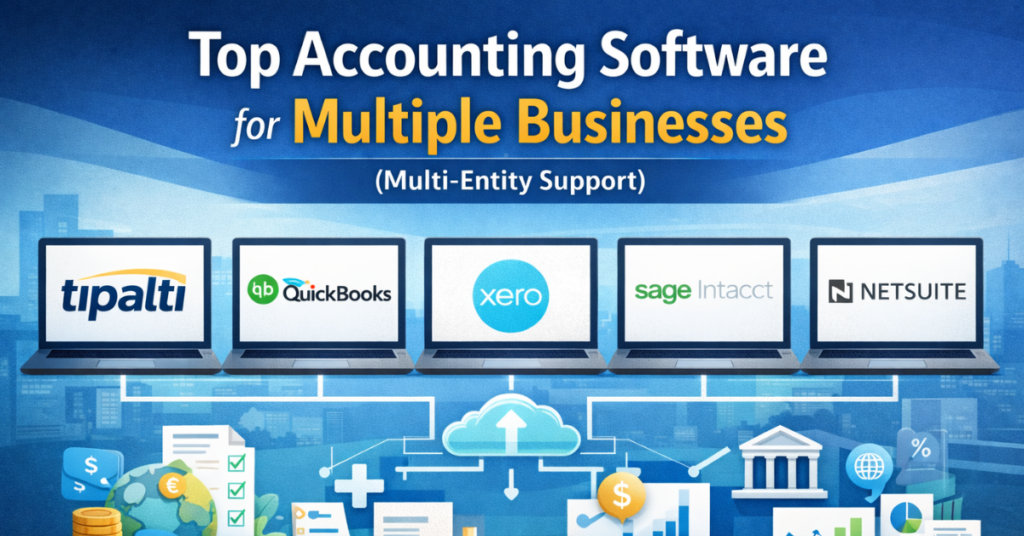
Top Accounting Software for Multiple Businesses (Multi-Entity Support)
The market offers several options that provide robust multi-entity accounting, AP automation, and ERP integration. Each solution varies in features, scalability, and pricing.
Tipalti
Tipalti specializes in AP automation, supplier onboarding, and global payments. Its system supports 200+ countries and multiple currencies, and provides OCR scanning, approval workflows, and intercompany transaction tracking. It is highly suitable for businesses needing enterprise-level automation while maintaining accurate audit trails and financial reporting.
QuickBooks
QuickBooks offers cloud-based and desktop multi-entity accounting solutions. Companies can manage multiple businesses, handle income and expenses, and integrate with third-party tools for enhanced project accounting. While QuickBooks is accessible for small to mid-sized companies, larger organizations may need additional integrations for consolidated reports and tax compliance.
Xero
Xero provides cloud accounting software for multiple entities with strong expense tracking, invoicing, and bank reconciliation. Its marketplace apps allow integration with ERP systems and AP automation, enhancing capabilities for multi-currency payments and financial dashboards.
Sage Intacct
Sage Intacct supports multi-dimensional accounting, revenue recognition, and GAAP compliance. It is particularly effective for mid-sized businesses requiring detailed financial reporting, project-level tracking, and intercompany transaction management.
NetSuite
NetSuite’s OneWorld ERP offers multi-entity, global accounting, and consolidated reporting in a single system. It supports project accounting, cash flow management, and multi-currency operations. Businesses gain centralized visibility across all entities while automating bank reconciliation, tax filing, and AP processing.
How to Choose the Best Accounting Software for Multiple Businesses?
When selecting a solution, companies should evaluate whether the software can handle multi-entity operations, offer real-time dashboards, and provide automated workflows for invoicing, expense tracking, and tax filing. Integration with ERP systems, supplier onboarding, and other business tools is also key. User adoption, ease of use, and scalability for future growth are important considerations for managing finances across multiple businesses effectively.
Common Mistakes to Avoid When Managing Multiple Business Accounts
Businesses often make mistakes like mixing transactions between entities, manually consolidating financial statements, neglecting compliance requirements, or underestimating the need for automation. Relying on spreadsheets or single-business software can create errors in financial reporting, mismanage cash flow, and complicate audit trails.
Industry-Specific Accounting Software for Multiple Businesses
Different industries have unique requirements. Service-based businesses often need project accounting and expense tracking, retail businesses may require inventory management, and SaaS companies need subscription billing and recurring invoicing. Software that addresses industry-specific needs helps ensure accurate financial management across multiple entities.
App Integrations That Extend Accounting Software Capabilities
Modern systems support integrations with payroll, CRM, payment gateways, ERP, and expense management apps. These integrations reduce manual work, improve data accuracy, and provide a centralized platform for financial reporting, AP automation, and bank reconciliation.
Security, Data Control, and User Access Management
Software should offer role-based access controls, encrypted data storage, and detailed audit trails. Businesses need to maintain compliance while controlling who can view or edit financial information. Multi-entity software often includes approval workflows and transaction-level security, making it suitable for enterprises with multiple subsidiaries.
Support, Training, and Customer Experience Matters
Effective support helps businesses implement software smoothly and manage ongoing financial operations. Training programs assist finance teams in understanding automated workflows, reporting dashboards, and intercompany transaction handling.
Onboarding and Setup Assistance
Support should include data migration, workflow configuration, and guidance on setting up invoicing, expense tracking, AP automation, and tax filing for multiple entities. Proper onboarding reduces errors and accelerates financial reporting accuracy.
Global Customer Support Availability
For companies operating across multiple countries, 24/7 support ensures that financial operations, bank reconciliations, and payment processing continue smoothly. Support across time zones helps maintain accurate real-time insights and cash flow management.
Free vs Paid Accounting Software for Multiple Businesses
Free tools may work for single businesses but lack multi-entity support, automation, and consolidated reporting. Paid solutions offer ERP integration, automated tax filing, AP automation, and scalable financial dashboards, making them better suited for companies managing several entities.
Resources and Tools for Multi-Business Owners
Multi-business owners benefit from financial dashboards, consolidated reports, compliance checklists, AP automation frameworks, and project-level tracking tools. These resources improve visibility, operational efficiency, and decision-making for all entities.
Productivity software enables businesses to manage tasks, automate processes, and scale operations efficiently, driving sustainable growth across teams.
Frequently Asked Questions (FAQs)
What is accounting software for multiple businesses?
Accounting software for multiple businesses is a system that helps companies manage the finances of more than one business entity from a single platform. It allows tracking of income, expenses, invoices, and accounts payable for each entity while providing real-time insights and consolidated financial reporting across all businesses.
How does multi-entity accounting software work?
Multi-entity accounting software keeps each business entity’s data separate while combining it in a centralized system for reporting. It automates tasks like invoicing, expense tracking, payroll, tax filing, and intercompany transactions, giving managers and owners financial visibility at both the entity and enterprise level.
Why do businesses need specialized software to manage multiple entities?
Managing multiple businesses with spreadsheets or single-business tools often causes errors, delays, and compliance issues. Specialized multi-entity accounting software simplifies expense tracking, AP automation, bank reconciliation, and project-level reporting, making it easier to maintain accurate financial statements and cash flow management.
What core features should I look for in multi-business accounting software?
Essential features include invoicing and billing for multiple entities, expense tracking, payroll management, tax handling, consolidated reporting, real-time dashboards, AP automation, bank reconciliation, and audit trails. These tools help businesses manage finances efficiently and maintain compliance.
Can accounting software handle multi-currency transactions?
Yes. Cloud-based multi-entity accounting software allows companies to manage multiple currencies for global operations. It automates currency conversions, tracks foreign exchange gains or losses, and ensures that financial reporting is accurate for international businesses.
How does invoicing work across multiple businesses?
Each entity can generate professional invoices using the software. Recurring invoices can be automated, and online payment options are integrated. Advanced systems use OCR scanning to read invoices, categorize expenses, and route them through approval workflows for faster processing.
Can I track expenses separately for each business?
Yes. Multi-entity accounting software allows detailed expense tracking per business or project. Each expense can be categorized, allocated to the right entity, and consolidated for reporting. This ensures managers can see real-time financial insights without mixing data across entities.
Does the software support payroll for multiple businesses?
Modern accounting systems handle payroll for multiple entities, including tax calculations, compliance, and reporting. Payroll data can integrate with expense tracking, accounts payable, and financial dashboards, making it easier to manage salaries across multiple businesses.
How does tax filing work for multiple companies?
The software helps generate entity-level tax reports and consolidated statements. It tracks tax obligations, automates calculations, and stores a full audit trail for each entity. Businesses can file taxes accurately and maintain GAAP-compliant reporting for audits.
What is AP automation, and how does it help multi-entity businesses?
Accounts payable (AP) automation automates supplier invoice processing, approval workflows, and payment scheduling. It reduces errors, saves time, and improves cash flow management. AP automation also provides a complete audit trail for compliance purposes across multiple entities.
Can I get real-time financial reports for all businesses in one place?
Yes. Multi-entity accounting software provides real-time dashboards that show income, expenses, cash flow, and project performance for each business. Managers can see entity-level details and consolidated insights on one platform, which helps in financial planning and decision-making.
What is the difference between single-business and multi-entity accounting software?
Single-business software manages only one company’s finances, often requiring spreadsheets to consolidate multiple entities. Multi-entity software supports separate accounting for each entity, intercompany transactions, consolidated reports, and global payment management, making it ideal for companies with more than one business.
How do integrations improve accounting software for multiple businesses?
Integrations with ERP systems, payroll platforms, payment gateways, and expense management apps reduce manual work, improve data accuracy, and allow seamless bank reconciliation. Integrations also extend financial reporting capabilities, enabling managers
Is cloud-based accounting software better for multiple businesses?
Cloud-based software allows real-time access to finances, dashboards, and consolidated reports from anywhere. It supports global payments, multi-currency operations, and centralized financial management, making it easier to manage multiple companies without relying on local servers or spreadsheets.
What are the most common mistakes businesses make when managing multiple accounts?
Common mistakes include mixing transactions between entities, using spreadsheets for consolidation, ignoring compliance, not tracking expenses per entity, and neglecting AP automation. These errors can lead to inaccurate financial statements, delayed tax filing, and poor cash flow visibility.
Final Verdict: Choosing the Right Accounting Software for Multiple Businesses
Selecting the right accounting software for multiple businesses depends on business size, complexity, and growth plans. Companies that adopt multi-entity accounting software gain centralized control, accurate reporting, automated workflows, and a full overview of finances across all entities. This helps reduce errors, improve compliance, and enhance cash flow management, allowing finance teams to focus on strategic growth rather than manual bookkeeping.
Disclaimer:
“The information in this article is for educational purposes only. It provides a general overview of accounting software for multiple businesses and related features. It does not constitute professional, legal, or financial advice. Readers should consult qualified experts before making decisions, as results may vary depending on each company’s specific circumstances.”