

In today’s fast-paced retail world, Wi-Fi ESL systems let stores update prices instantly, improve accuracy, and stay ahead of customer and competitor demands. Consider this situation: it’s 5:45 PM on a busy Friday, and your company’s flagship store is packed. A competitor two miles away just cut prices on a critical product line, and your social media team has approved a “happy hour” sale for the next two hours to drive foot traffic. This promotion will span over 15,000 SKUs and needs to be completed in 15 minutes.
In a world driven by technology and customer needs, the ability to execute at speed and with precision is no longer a competitive edge, but rather a core necessity. This is the environment in which vendors of Wi-Fi-enabled Electronic Shelf Labels (ESLs) are moving from being a ‘nice to have’ to a ‘need to have’ for customers.
For B2B decision makers in retail, grocery, and high-volume specialty stores, the decision to invest in a pricing infrastructure is certainly a decision of merit. From a communications perspective, especially in terms of ESLs being connected to existing Wi-Fi networks, the decisions made will have a significant impact on scalability, responsiveness, and the total cost of ownership. This paper examines why, for retailers with time-sensitive needs, Wi-Fi ESLs https://www.zhsunyco.com/tr/digital-price-tag/ have become the solution of choice.
The Harsh Reality of Time: Why The New Retail Economy Values Speed More Than Ever
Retail has outpaced the ability of manual processes to keep up for several reasons:
- The Customer Expectation of Omnichannel: Customers will not trust a brand when they see different prices or promotions based on where they are (e.g., store, app, website). A brand must execute real-time price synchronizationacross channelsl to earn consumer trust, which requires a digital shelf in direct connection with the brand’s e-commerce system.
- Competitively Priced Products & Continuous Dynamic Pricing: With the ability to compare prices universally and with the presence of aggressive competition, pricing has shifted from a weekly or dailychore to a minute-by-minute chore. Retailers must respond to a competitor’s price change, a consumer’s localized demand, or a perishable good that needs to be sold.
- Economic Pressures for Labor & Pricing Accuracy: With the rising price of labor, it is not financially sound to have employees spend several hours on a task that is prone to errors. Pricing errors lead to direct and immediate loss to the bottom line and result in a loss of trust in the brand.
A Wi-Fi ESL system attempts to remove these problems by digitalizing workflows that are generally manual and human-reliant. The ‘fast-paced environment’ isn’t only about the customer movement in the store; it’s the speed at which business decisions are made, and the ability to act on those decisions throughout the entire chain.
How Wi-Fi ESLs Work and Why They’re Wi-Fi Dependent
As it stands, a Wi-Fi ESL system prioritizes the existing wireless local area network (WLAN) for communication. Each smart price tag contains a Wi-Fi module that lets it connect to the store’s router (similar to any smartphone or laptop).
Here’s a general overview of the process:
- A price modification is initiated in the retailer’s central pricing or ERP software.
- These changes get sent over the Internet to a cloud-based ESL management software.
- The software sends the update to a particular retail store over its local Wi-Fi network.
- The Wi-Fi access points in that store will refresh the change throughout the network.
- The ESLs disperse the updated information to the customers. This process will take about 1-2 minutes to complete a store-wide update.
The key benefit of this design is direct IP communication. Each tag can be individually or collectively addressed without any additional gateways or custom radio hubs. This provides a network design simplification and utilizes the IT ecosystem retailers have deployed.
Still, this decision comes with some technical challenges due to the use of Wi-Fi. For this purpose, not every Wi-Fi network can be used.
A standard consumer home Wi-Fi router will not work. Retail solutions need enterprise-grade, high-density Wi-Fi equipment capable of supporting hundreds or even thousands of concurrent ESL connections (which have low bandwidth but critical performance requirements) in addition to the regular customer and POS traffic. The performance of this network is critical; a price change is as good as the wireless network supporting it.
The Other Advantages: Beyond Just Velocity of Price Changes
While this is the main benefit, a well-executed Wi-Fi ESL system can also provide significant improvements throughout the operation with an impact that goes beyond velocity.
Unmatched Agility and Centralized Control. Centralized management can run pricing initiatives across the entire chain, down to store, or even price changes down to an aisle level, which can drive very complex pricing sschemeses including time-of-day pricing, rapid flash sales, localized offers, etc., all without any manual work at the store level.
Seamless Integration with Existing Technology Stacks: Wi-Fi ESLs don’t have issues with other systems. Operating on a standard IP network ensures a smoother integration with cloud-based POS systems, inventory management systems, and pricing engines. This integration creates a closed-loop ecosystem where a stock-level alert on an IoT smart shelf could trigger a promotional price ESL.
Reduced Infrastructure Complexity and Increased Scalability: The elimination of the need for separate gateways and proprietary mesh networks increases simplicity and reduces the amount of hardware needed. Scaling to a new store or adding new tags is as simple as connecting the new devices to the existing Wi-Fi SSID (network name).
More Available Data and Improved Diagnostics: Proactive maintenance, where systems are kept from failing, is a result of IP connectivity, with maintenance based on tag status (battery level, signal power, time of last update) being moved from a reactive to a predictive model. This ensures a dead tag scenario is less likely and improves overall system integrity.
A retailer considers the hardware that will define the most visible end of this system. For this, understanding the endpoint is critical. An essential step is the review Zhsunyco has done on various designs of digital smart price tags, as well as their connectivity and form factor options.
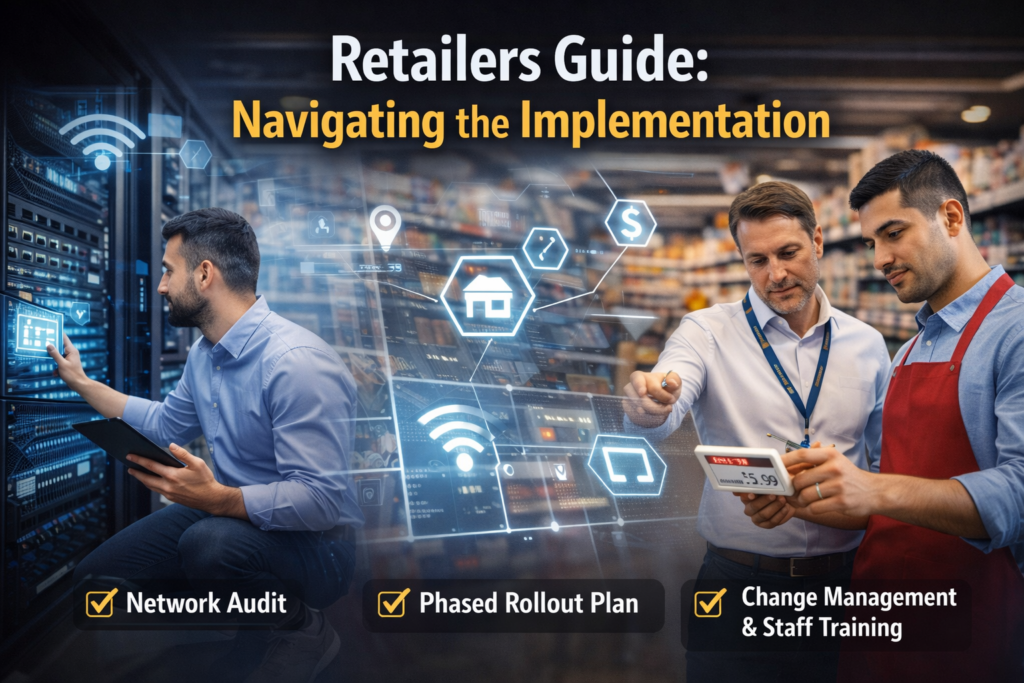
Retailers’ Guide: Navigating the Implementation
A retailer must understand that successfully deploying a Wi-Fi ESL system is an involved process that has implications beyond the buying of the tags. It is first and foremost an IT and operations project.
Network Audit: This is the first and non-negotiable step in the process. Work with your IT staff or a network expert to conduct a wireless site survey. You will need to determine coverage on the network to ensure that ESL tags will work from all locations, including challenging spaces like metal freezer aisles, planograms stocked to extremes, and backroom stock areas. The network has to be designed to support high ESL device usage and will need to be focused on traffic for ESL.
Phased Rollout Plan: The strategy for deployment should avoid a “big bang” approach, as this is risky. Rather, the first step is to set a pilot for one store or, at most, one high-velocity department (dairy or promotions) to test network capacity, evaluate the update process, and train your support team. The pilot should be used to create the deployment playbook for subsequent stores.
Change Management and Staff Training: The electronic shelf labels will certainly alter workflows. For example, store associates will no longer be printing and placing shelf labels, but will have to perform a manual sync check or identify a tag with a low battery. Staff communication and training turn potential resistance to the new workflows into a positive empowerment as the system champions.
The Future Connected Shelf: Where Wi-Fi ESLs Are Heading
Wi-Fi ESL systems do more than solve a store’s immediate pricing problems. They also build a digital foundation for future store innovations. As a connected IP device on the network, the tag transforms into a multifunctional sensor and interaction point.
Integration into IoT Ecosystems: An ESL could become a part of a broader Internet of Things ecosystem. Contextual information could be displayed on the ESL based on data from other devices, such as smart shelves that track weight or RFID readers that track inventory.
Enhanced Customer Interaction (NFC/QR): Numerous contemporary Wi-Fi ESLs have integrated NFC chips or QR codes. In this instance, the tag’s connection used for content management allows a customer’s tap or scan to trigger rich media, or provide in-depth information on sustainability, allergens, and so on, thereby integrating a digital layer to the physical object.
“Discover how cutting-edge technology trends are transforming HR leadership, driving efficiency, engagement, and strategic decision-making in modern workplaces.”
Frequently Asked Questions (FAQs)
What are Wi-Fi ESL systems in retail?
Wi-Fi ESL (Electronic Shelf Label) systems are digital price tags that connect to a store’s Wi-Fi network. They allow retailers to update prices, promotions, and product details instantly from a central system without printing paper labels.
How do Wi-Fi electronic shelf labels update prices?
When a price changes in the retailer’s ERP or pricing software, the update is sent to cloud-based ESL management software. From there, it travels through the store’s Wi-Fi network to each label, usually updating the whole store within 1–2 minutes.
Why are Wi-Fi ESL systems important for modern retail?
Retail moves fast. Competitors change prices quickly, and customers expect the same price online and in-store. Wi-Fi ESL systems help retailers stay accurate, react in real time, and avoid costly pricing mistakes.
Can Wi-Fi ESLs handle dynamic pricing?
Yes. Wi-Fi ESL systems support dynamic pricing, including flash sales, time-based discounts, and location-specific offers. Retailers can change thousands of SKUs in minutes without manual work.
Do Wi-Fi ESL systems reduce pricing errors?
Absolutely. Manual label changes often lead to mistakes. Digital labels reduce human error by syncing directly with the central pricing system, improving pricing accuracy and customer trust.
What kind of Wi-Fi network is required for ESL systems?
Retailers need enterprise-grade, high-density Wi-Fi equipment. A basic home router will not work. The network must handle hundreds or thousands of ESL connections along with POS systems and customer traffic.
How scalable are Wi-Fi ESL systems for large retail chains?
Wi-Fi ESL systems are highly scalable. Adding new stores or tags is simple—connect them to the existing Wi-Fi network and configure them in the management software. No separate gateways are usually required.
Are Wi-Fi ESLs secure?
Yes, when properly configured. Enterprise Wi-Fi networks use encryption, secure authentication, and network segmentation to protect pricing data and prevent unauthorized access.
How do Wi-Fi ESLs support omnichannel retail?
They help keep prices consistent across physical stores, websites, and mobile apps. When prices update centrally, in-store labels reflect the same information customers see online.
Can Wi-Fi ESL systems integrate with POS and inventory systems?
Yes. Since they operate over standard IP networks, Wi-Fi ESLs integrate smoothly with POS systems, ERP software, and inventory management tools. This allows automatic price updates based on stock levels or promotions.
What is the typical battery life of Wi-Fi ESL tags?
Most Wi-Fi ESL tags are designed for low power usage and can last several years on a single battery, depending on update frequency and screen type.
Do Wi-Fi ESL systems help reduce labor costs?
Yes. Staff no longer need to print and replace paper labels across thousands of products. This saves time and allows employees to focus on customer service and store operations.
What should retailers check before installing Wi-Fi ESLs?
A network audit is essential. Retailers should conduct a wireless site survey to ensure strong coverage in all areas, including freezer aisles, high metal shelving, and storage rooms.
Can Wi-Fi ESLs improve customer engagement?
Many modern Wi-Fi ESLs include NFC or QR codes. Customers can tap or scan for more product information, promotions, or reviews, adding a digital experience to the physical shelf.
Are Wi-Fi ESL systems a good long-term investment?
For high-volume retailers, grocery stores, and specialty chains, Wi-Fi ESL systems often deliver strong long-term value. They improve speed, pricing accuracy, operational efficiency, and prepare stores for future smart retail technologies.
Conclusion
Wi-Fi ESL systems are becoming essential for modern retail. They help stores update prices quickly, reduce errors, save labor costs, and improve customer trust. With strong network planning and proper setup, they create a smart, scalable foundation for the future of connected retail.
Disclaimer:
“This article is for informational and educational purposes only. It does not provide personal, financial, or professional advice. Readers should verify information and consult qualified experts before making business or technical decisions.”