
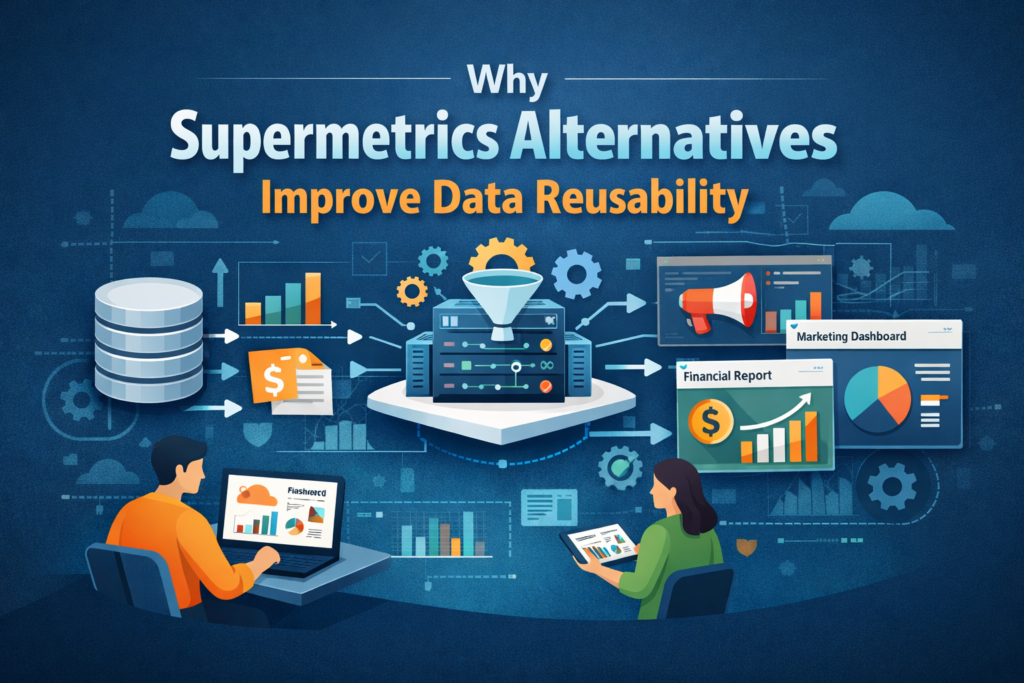
Data reusability has become a critical factor in modern analytics environments. As organizations collect data from multiple platforms, the same datasets are often needed across different reports, teams, and tools. However, when data pipelines are tightly tied to specific dashboards or connectors, reusing that data becomes difficult.
Analysts may recreate calculations, duplicate datasets, or rebuild pipelines to meet new requirements. Over time, this reduces efficiency and increases inconsistency. To address this, many organizations explore Supermetrics Alternatives that improve data reusability by structuring analytics workflows for flexibility and consistency.
What does Data Reusability mean?
Data reusability refers to the ability to use the same dataset or transformation logic across multiple reporting environments without rebuilding it. Instead of creating separate pipelines for each dashboard, reusable data can support different use cases simultaneously.
In practice, this means that one dataset can power:
- Marketing performance dashboards
- Financial reporting views
- Operational analytics tools
- Executive summary reports
Why Reusability Breaks Down?
In many analytics environments, data pipelines are built for specific dashboards rather than for broader reuse. Transformation logic is often embedded directly within reports, making it difficult to extract and apply elsewhere.
Common causes of poor reusability include:
- Calculations defined inside individual dashboards
- Datasets structured for single-use reporting
- Inconsistent schema across platforms
- Limited access to intermediate data layers
Centralized Transformation Layers
One of the main ways Supermetrics Alternatives improve reusability is by centralizing transformation logic. Instead of defining metrics separately in each dashboard, calculations are managed in a unified processing layer.
One Source Of Logic
Centralized transformations ensure that the same metric definitions are applied across all reports.
Reusable Data Outputs
Processed datasets can be reused across multiple dashboards without modification. This structure eliminates the need to recreate calculations repeatedly.
Decoupling Data From Reporting Tools
Reusability improves when data preparation is separated from visualization. If dashboards contain embedded logic, transferring or reusing data becomes difficult. Supermetrics Alternatives decouple ingestion and transformation from reporting layers, allowing datasets to exist independently.
Benefits of decoupling include:
- Easier reuse across different BI tools
- Simplified dashboard creation
- Reduced dependency on specific platforms
Standardized Data Structures
Reusability also depends on consistent schema design. If datasets use different structures across systems, reusing them becomes complex. Supermetrics Alternatives often standardize schema during the ingestion and transformation stages.
Standardization allows datasets to:
- Maintain consistent field definitions
- Support multiple analytical use cases
- Integrate easily with new platforms
Structured data is easier to reuse.
Supporting Multi-Use Analytics
Reusable data enables teams to build multiple analytical outputs from the same foundation. Instead of creating separate pipelines for each department, a single dataset can serve various needs.
For example:
- Marketing teams analyze campaign performance
- Finance teams review revenue attribution
- Leadership teams monitor overall business trends
Reducing Duplication And Errors
When data is not reusable, teams often duplicate pipelines or calculations. This duplication increases the risk of inconsistencies.
Key advantages include:
- Fewer duplicated calculations
- Lower risk of metric inconsistencies
- Easier maintenance of reporting systems
Improving Data Consistency Across Teams
Reusability supports consistency across departments. When all teams use the same datasets, metrics remain aligned across reports. Without reusability, different teams may calculate the same metric differently, leading to conflicting interpretations.
Enabling Faster Reporting Development
Reusable data accelerates reporting development. Instead of building pipelines from scratch, analysts can use existing datasets to create new dashboards quickly.
This allows organizations to respond faster to new business questions without increasing operational complexity. Faster development improves overall analytics agility.
Embedding Reusability Into Architecture
Long-term reusability requires structural design rather than ad hoc solutions. Centralized ingestion, standardized transformations, and independent data layers form the foundation of reusable analytics systems.
Platforms positioned as a Dataslayer reusable data platform emphasize structured orchestration to ensure that datasets can be reused across multiple reporting environments without duplication. Embedding reusability into infrastructure ensures scalability and flexibility.
Recognizing Reusability Gaps
Organizations often notice reusability gaps when analysts repeatedly rebuild similar reports or recreate calculations for new dashboards. Frequent duplication of pipelines or inconsistent metric definitions indicates that data is not structured for reuse. Addressing these gaps improves efficiency and reduces long-term maintenance effort.
Why Data Reusability Strengthens Analytics
Analytics systems should support growth and adaptation. As reporting needs evolve, data should remain flexible and reusable. Supermetrics Alternatives improve data reusability by centralizing transformations, standardizing schema, and decoupling data from reporting tools.
This approach allows organizations to reuse datasets across multiple use cases without duplication. As a result, analytics workflows become more efficient, consistent, and scalable, enabling teams to focus on insights rather than rebuilding data pipelines.
“Explore the top simple inventory software in 2026, comparing key features, pricing, and benefits to help businesses streamline stock management efficiently.”
Frequently Asked Questions (FAQs)
What are Supermetrics alternatives, and why do people use them?
Supermetrics alternatives are tools that help collect, transform, and manage data from different platforms. People use them when they want more flexibility, better data control, and improved data reuse across multiple reports and teams.
How do Supermetrics alternatives improve data reusability?
They separate data collection, transformation, and reporting. This makes it easy to reuse the same cleaned and structured data across different dashboards without rebuilding everything again.
What is data reusability in simple terms?
Data reusability means using the same dataset or logic in multiple places without creating it again. One dataset can support many reports, saving time and effort.
Why is data reusability important for businesses?
It helps teams work faster, reduces errors, and keeps reports consistent. Instead of duplicating work, teams can focus on insights and better decisions.
What causes poor data reusability in analytics systems?
Common reasons include hard-coded calculations in dashboards, messy data structures, and a ack of a central place for data transformations.
How does centralizing data transformations help?
When all calculations are done in one place, every report uses the same logic. This avoids confusion and ensures that numbers match across teams.
What does it mean to decouple data from dashboards?
It means separating data processing from visualization tools. Your data is prepared independently, so you can use it in any dashboard or reporting tool.
Can reusable data be used across different BI tools?
Yes, that’s one of the biggest benefits. Once your data is properly structured, you can connect it to multiple BI tools without changing the core dataset.
How do standardized data structures improve reusability?
Standard formats make data easier to understand and use. When fields and naming are consistent, teams can quickly reuse datasets without extra work.
Does data reusability reduce errors in reporting?
Yes, it reduces mistakes because the same data and calculations are reused instead of being recreated each time differently.
How does reusable data help different teams?
Marketing, finance, and leadership teams can all use the same dataset for their needs. This keeps everyone aligned and avoids conflicting numbers.
Is data reusability useful for growing businesses?
Absolutely. As a business grows, reporting needs increase. Reusable data makes it easier to scale without constantly rebuilding pipelines.
How do Supermetrics alternatives support faster reporting?
They provide ready-to-use datasets. Analysts can build new dashboards quickly instead of starting from scratch every time.
What are the signs that your data is not reusable?
If teams keep rebuilding reports, duplicating data, or getting different results for the same metric, it’s a clear sign of poor reusability.
How can a company improve data reusability in the long term?
By using centralized data pipelines, standardizing data formats, and separating data processing from reporting tools. This creates a strong foundation for scalable analytics.
Conclusion
In conclusion, Supermetrics alternatives help businesses reuse data more effectively by organizing workflows in a smarter way. This reduces duplication, improves consistency, and makes reporting faster and easier. With a better data structure, teams can focus more on insights instead of rebuilding pipelines.
Disclaimer:
“This article is for educational purposes only and provides general information about data tools and workflows. It does not offer professional advice. Results may vary by use case, so evaluate solutions carefully before making decisions.”
