
Custom MVP Development is the process of building a simple version of a product that contains only the essential parts needed to learn from real users, attract early adopters, and test demand in the market. For many startups in the United States and around the world, a Minimum Viable Product provides a clear path to idea validation, helps shape product decisions, and brings real user data that boosts investor confidence.
In this guide, you will read about what MVP software means, why a Startup MVP matters more in 2026, how to build it step‑by‑step, and what you should prepare for when working with an MVP development partner. You will also learn about MVP cost, how to plan an MVP timeline, and how to go from MVP launch to startup growth. This article explains every part of MVP consulting, building, testing, and improving for early and long‑term success.
What Is Custom MVP Software Development?
Custom MVP software development means creating a digital product, such as a SaaS MVP, a Web portal MVP, or a mobile app MVP, that is built specifically for the unique needs of a startup. The purpose of custom development is not to build a finished product right away, but to create something that can be used to gather user feedback, test assumptions about the market, and measure MVP validation before investing more time and money. Custom MVP work focuses on the essential parts of the product that deliver value and represent the core features that are most important to early adopters.
MVP meaning in simple terms
A Minimum Viable Product is the simplest working version of a product that can be released to real users to learn whether the product idea has value. The idea is to create something that works just enough so that users can try it and provide real reactions. Rather than spending months building every feature, a startup builds an MVP to start receiving MVP feedback early. This input helps with decisions about what to do next and prevents wasted investment in untested features. An MVP is not a prototype, not a simulated version of the product, and not a full solution.
Difference between MVP, prototype, and full product
An MVP is different from a prototype because an MVP actually performs real functions that users can use, while a prototype is usually a visual or structural mockup that demonstrates how something could look or operate. A prototype may not be used by customers to accomplish real tasks. A full product, on the other hand, goes well beyond what an MVP does. A full product includes many extra features, integrations, and refinements that are not necessary for early learning. A startup builds an MVP first, gets MVP feedback, and then chooses which features to add in future versions. This saves time and money and focuses development on what matters for product‑market fit.
Why Custom MVP Software Development Matters for Startups in 2026
Custom MVP software development matters in 2026 because the market expects real value fast, and investors are more likely to support startups that can prove their idea with actual user engagement. In 2026, technologies such as AI MVP, AI‑driven MVP, and other automation tools will be available, but nothing replaces the insights that real users provide when they interact with a customized product.
Faster validation
Startups rely on fast validation to find out whether people actually care about their product idea. By building a Startup MVP that includes the essential features that a user needs, the company can see if real users will sign up, interact, and return. This process of MVP validation saves time and points the product in the right direction before scaling or adding bigger features.
Lower risk and smarter spending
Every startup has a budget for MVP cost and MVP timeline planning. When a company builds a custom MVP with only the necessary elements, it avoids spending on unproven ideas. This means the startup does not waste money on features that users do not want. Instead, it spends resources on learning what parts of the product matter most. This careful approach to spending makes the product development process safer and gives founders more control over where money goes.
Key Benefits of Custom MVP Software Development
The benefits of Custom MVP Development include the ability to test ideas in real conditions and learn directly from users. A custom MVP gives founders a way to build MVP features that are specific to a unique product idea rather than using one‑size‑fits‑all solutions. Custom products allow for MVP architecture that supports future scaling, which can make upgrading to a full product easier later. It also gives the startup full ownership of the code, integrations, and data, which is important for long‑term MVP growth.
Another benefit is improved investor confidence. When a startup has a working MVP with real metrics and engagement data, investors can evaluate risk more accurately and support teams with funding. A custom MVP also supports a clear MVP launch strategy, where teams can build according to an MVP roadmap that guides future development.
Custom MVP vs Generic or Off‑the‑Shelf Solutions
When a startup chooses between custom development and generic tools, it must weigh long‑term needs against short‑term convenience. Generic or template‑based solutions can get something working quickly, but these products often cannot be changed easily or scaled later. A generic product might work well for initial learning, but it may limit how the startup can add advanced capabilities such as MVP AI features, MVP machine learning, or specialized workflows.
Custom MVP allows the product to grow in ways that generic solutions cannot support. A custom path gives a startup complete control over MVP integrations, user experience, and the overall direction of the product. Because custom work is planned around the specific goals of the product, it usually offers a better foundation for future versions and long‑term success.
“Explore how Enterprise Risk Management Technology empowers businesses to anticipate risks, strengthen controls, and drive smarter decision-making.”
When Should a Startup Choose Custom MVP Software Development?
Startups should choose custom MVP software development when they want to build a product that is not easily served by existing tools and when they need real user insights before spending heavily on full‑scale product development. Custom MVP is ideal when the product has unique features that require a specific technical design, when the business model depends on user experience differences, or when the product must scale beyond simple tools.
Custom development is helpful when the product aims to solve a complex problem, needs advanced MVP architecture design, or requires specialized integrations like cloud services, real‑time data processing, or third‑party platforms. When a product idea is new and has no direct comparison, custom development gives a startup the flexibility to try, learn, and adapt.
Step‑by‑Step Process of Custom MVP Software Development
The process of building a custom MVP involves a series of steps that reduce uncertainty and move a startup from idea to real user testing. The process begins with clear planning and understanding of what must be learned at each stage.
Discovery and requirements
In the discovery phase, the startup reviews the idea and identifies what problem the MVP should solve. This includes understanding the target users, their goals, and the assumptions that must be tested with real usage. During this step, teams gather business goals, market research, and preliminary feature lists.
Planning and specification
Once the idea is clear, the next step is to create a detailed plan and specification for the product. Teams decide which MVP features matter most and create a blueprint that guides developers and designers. This serves as a foundation for later work and helps define priorities.
UI/UX visualization
After planning, designers begin creating user interface designs and user experience flows. This includes maps of how users will interact with the product, how screens connect, and how the product provides value. This visualization helps communicate what the product will look like and how users will feel when using it.
Development and testing
The actual coding begins when developers start building the MVP frontend, MVP backend, database, and integrations. During this phase, MVP testing and MVP QA are practiced frequently to verify that the product works as designed. Problems are identified and solved before the product is released.
Launch and iteration
After development and testing, the product is released for a group of real users. This is the MVP launch phase, where founders collect MVP feedback and measure how users interact with the product. The startup then makes changes based on real data, adjusting features, fixing bugs, and adding improvements in future versions.
Features to Include in Your First MVP (Must‑Have Checklist)
Your first MVP should focus only on features that directly support your value proposition and help you learn from users. Strong choices for core features include easy login, essential actions users must take, and basic analytics to track usage. Avoid adding features that do not provide learning at this stage. The goal is to create something simple but functional so that users can engage and provide feedback. This approach supports faster learning and keeps development focused on what matters.
Common Mistakes to Avoid in Custom MVP Software Development
A frequent mistake in MVP work is adding too many features too early. When teams try to include every possible idea at the beginning, it delays the MVP launch and hides what really matters to users. Another mistake is ignoring the feedback loop. Real user feedback is the most important data you can collect, so skipping this step limits learning. Choosing development partners without domain knowledge or experience with similar products also leads to slow progress and higher cost.
Missing MVP roadmap planning or ignoring future growth and scalability leads to problems later on. When a product cannot grow beyond its initial version, the team must redo work and spend more than necessary. Teams should avoid these mistakes and focus on learning and adjusting, rather than building prematurely.
Typical Costs of Custom MVP Software Development in 2026
When planning for MVP development, startups often want a clear idea of MVP cost and what influences that cost. The cost of a custom MVP depends on many factors, including the product’s complexity, the number of MVP features, quality expectations, and the experience of the MVP development partner.
Cost ranges
The typical price range for a custom MVP in 2026 can be seen below:
| MVP Type | Estimated Cost | Typical Delivery Time |
| Basic MVP | $10,000 to $30,000 | 6 to 10 weeks |
| Standard MVP | $30,000 to $75,000 | 10 to 16 weeks |
| Advanced MVP | $75,000+ | 16+ weeks |
Costs vary based on the level of design, integrations, and technical requirements such as MVP AI features, cloud services, and third‑party systems.
Factors that affect price
Several factors influence how much an MVP will cost. The number and complexity of features matter, as well as whether the product supports multiple platforms, such as web and mobile. The level of design detail and backend complexity also influences cost. When data security or compliance is important, additional work is required, which increasesthe price. Your choice of MVP team also affects cost, because more experienced developers will charge more but may also deliver faster and with higher quality.
Timeline and Milestones for MVP Launch
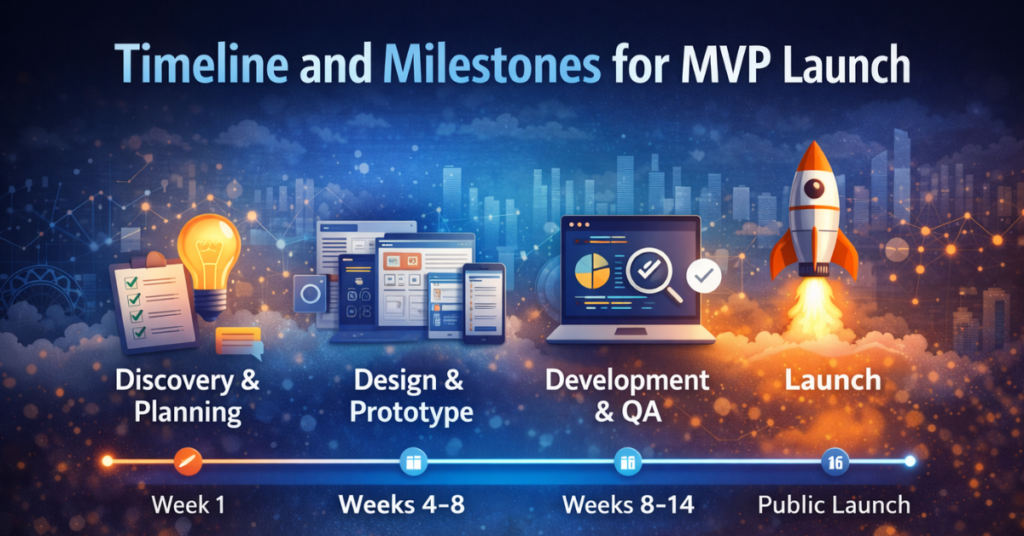
A typical timeline for building a custom MVP begins with discovery and planning in the first weeks, followed by design and prototype creation, then development and quality assurance, and finally a public launch. Most MVP projects are completed within a period of around eight to sixteen weeks. Mapping this schedule out clearly as an MVP launch plan helps teams set expectations and monitor progress.
How to Validate Your MVP Idea Before Development
Before development begins, you can validate your MVP idea by conducting user research, creating simple landing pages, collecting emails, or testing prototype flows with users. This helps confirm that your idea has demand and gives early insights into how users think. This validation step is a form of prototype testing that saves time and improves your chances of building something people truly want.
Choosing the Right Tech Stack for Custom MVP Software Development
Deciding which technologies to use for your MVP is an important technical decision. You want tools and platforms that help you build quickly, perform well, and support future growth. Many teams choose frameworks like MVP Python for backend logic, MVP React for frontend interfaces, and reliable MVP databases for storing data. These stacks are familiar to many developers and provide a good balance of speed and flexibility.
AI and Automation Trends Shaping MVP Development in 2026
In 2026, many MVP design and development teams include AI components or automation features in their offerings. This might mean including features like predictive suggestions, automated analytics, or smart workflows that make the product more engaging. AI components can be added in ways that enhance learning and improve user engagement, but they should be part of your plan only if they help with MVP feedback or real usage data.
Security, Compliance, and Data Protection Best Practices
Security and compliance are especially important for products that handle personal, financial, or regulated data. Your custom MVP should follow good practices for data encryption, secure login systems, and compliance with legal standards. This is not a one‑time effort. Ongoing MVP post‑launch maintenance makes sure that the product remains safe for users, which in turn builds trust and keeps early users engaged.
Offshore vs In‑House vs Dedicated Teams – Which Is Better?
When choosing who will build your MVP, startups often face a choice between hiring an in‑house team, working with an offshore MVP development team, or assembling a dedicated MVP team. In‑house teams give you direct control, while offshore teams often offer more affordable rates and access to a wider talent pool. Dedicated teams provide a balance between the two, offering consistent focus on your product with experience in working with startups.
Each option has strengths, and the best choice depends on your budget, timeline, and project complexity. Some startups benefit from starting with an offshore team, and then transitioning to a hybrid or dedicated team as the product grows.
Cooperation Models for Startups
When working with an MVP partner, you will encounter different cooperation models that define how work is organized, paid for, and delivered.
Fixed cost
The fixed‑cost model means that a clear budget and payment terms are agreed upon before work begins. This works well when the product scope is well understood.
Dedicated team
In a dedicated team model, you get a group of professionals assigned specifically to your MVP work. This helps maintain focus and continuity through all stages of development.
Time & materials
The time and materials model means you pay for the hours worked and the resources used. This is useful when the scope is likely to change as you learn more about your users.
Real‑World MVP Examples by Industry
Different industries use MVPs in various ways. A SaaS MVP might start with just a web dashboard and a few essential features that solve the main problem. A consumer mobile app MVP might begin with the core task the user wants to accomplish and skip optional extras. A marketplace MVP might start with user registration and a basic matching algorithm. Real-world examples help teams understand how others built early versions, learned from users, and improved over time.
Case Studies: Successful Custom MVP Software Development Projects
Many well‑known products began as MVPs with simple features that validated ideas. They used their early MVP results to secure funding, attract users, and improve their product. These case studies show that consistency, responsiveness to feedback, and a clear focus on learning are critical to finding success through MVP development.
Measuring MVP Success with KPIs and Metrics
After your MVP launch, you will want to measure how well your product is doing. Metrics such as user activation rates, retention, and engagement show whether users find value. Tracking how many users return, how long they spend using key features, and where they encounter problems gives you the data you need for future improvements. These measurements are part of your MVP success evaluation and guide decisions for the next stages of development.
Tools and Platforms for Faster MVP Development
Using the right tools can speed up development and provide insights. Tools that help with design, project tracking, analytics, and testing make it easier to build and monitor your product. These include systems for creating designs, tracking tasks, collecting user data, and testing functionality. When combined with a clear roadmap, these tools help teams build stronger MVPs faster.
Post‑Launch Growth and Scaling Strategy
Once your MVP has launched and early users are engaged, your focus shifts to growth. This means improving features based on early data, adding new functionality based on priority, and making sure that the product continues to satisfy users. A thoughtful approach to scaling can improve user experience and keep your product competitive.
Maintenance, Support, and Continuous Improvement
After launch, the work is not finished. Ongoing support and updates make sure that your product stays functional, relevant, and secure. Regular maintenance helps fix issues that emerge after launch and keeps users satisfied. This long‑term improvement is part of what turns an MVP into a stable product that supports real business outcomes.
How to Choose the Right Custom MVP Development Partner
Choosing the right partner for Custom MVP Development is one of the most important decisions for your startup. Look for a company with experience in startups, a clear portfolio of MVP consulting services, a proven history of meeting timelines, and the ability to communicate transparently about progress and challenges. A good MVP partner helps you make decisions that support Investor confidence, user growth, and product improvement.
Custom MVP Software Development Packages and Pricing Options
When you explore MVP packages, you will find options ranging from basic to advanced, depending on the product complexity and your startup’s needs. Basic packages might cover essential features and quick delivery, while more advanced packages include deeper design work, advanced integrations, or AI‑enabled features. Pricing options may be fixed cost, team‑based, or hourly, giving founders flexibility based on budget and goals.
“A comprehensive Business Management System enables data-driven insights, helping leaders make smarter, faster decisions for long-term growth.”
Frequently asked Questions (FAQs)
What is a Custom MVP and why do startups need it?
A Custom MVP is a simple version of a product built specifically for your startup. It includes only the core MVP features necessary to test ideas with real users. Startups need a Startup MVP to validate demand, collect MVP feedback, and make improvements before investing in a full product. This approach reduces risk and saves MVP cost.
How is an MVP different from a prototype or a full product?
A prototype shows how a product might look or work, but isn’t fully functional. A Custom MVP is a working version that users can interact with, while a full product has all features and refinements. MVPs help test user engagement and guide product decisions without overspending.
What are the key benefits of building a Custom MVP?
A Custom MVP Development lets startups validate ideas quickly, attract early adopters, and prove product-market fit. It also provides a clean MVP architecture, supports future MVP scalability, and allows startups to own the code and integrations, which boosts long-term growth and investor confidence.
How much does Custom MVP Development typically cost in 2026?
The MVP cost depends on complexity, platform, and features. Simple MVPs may cost $15,000–$30,000, while moderate ones with integrations cost $30,000–$60,000, and complex MVPs with AI or fintech features may exceed $100,000. Additional factors affecting cost include MVP UI/UX design, backend complexity, and MVP integrations.
How long does it take to build a Custom MVP?
A typical MVP timeline ranges from 8 to 16 weeks, depending on scope. Discovery and planning take 1–2 weeks, UI/UX design 2–3 weeks, development 4–8 weeks, and MVP testing and QA 1–2 weeks. A clear MVP launch plan helps keep the project on schedule.
What features should be included in the first MVP?
A Startup MVP should focus on core features that address the main problem your product solves. Extra features can be added later. Early MVP features often include essential workflows, user registration, basic analytics, and functionality needed to collect MVP feedback and test MVP validation.
How do startups validate their MVP idea before development?
Startups validate their ideas by conducting surveys, testing landing pages, or using simple MVP prototypes. This helps confirm demand before building a full product. Validation ensures the MVP launch targets features that matter and reduces the risk of wasted development costs.
Should a startup choosea custom MVP or an off-the-shelf solution?
Custom MVP Development is best when the product requires unique features, specific MVP architecture design, or advanced MVP scalability. Off-the-shelf solutions are faster and cheaper but may limit future customization. Choosing the right approach depends on long-term goals and technical feasibility.
What is the difference between offshore, in-house, and dedicated MVP teams?
Offshore MVP development offers cost savings and access to specialized talent. In-house teams provide direct control but can be more expensive. A dedicated MVP team combines focus and experience while remaining flexible. The choice depends on the MVP timeline, budget, and skill requirements.
How can a startup attract investors with a Custom MVP?
Investors want to see real Startup MVP usage, engagement metrics, and validated MVP features. A functional MVP software with user data demonstrates technical feasibility and market demand, which builds credibility and increases the chance of funding.
What is MVP iteration, and why is it important?
MVP iteration is the process of improving the product based on real MVP feedback and usage data. Iterations help refine MVP features, enhance MVP UX/UI, and ensure that the product better fits user needs. This approach reduces risks and supports Startup growth.
How do you measure the success of an MVP?
MVP success is measured using metrics like user engagement, retention, conversion rates, and feedback collected during MVP testing. Tracking MVP validation and real user behavior helps guide future updates and ensures the product is moving toward product-market fit.
What are the common mistakes startups make in MVP development?
Common mistakes include building too many features too soon, skipping MVP testing, ignoring user feedback, choosing inexperienced MVP development partners, and overlooking MVP scalability. Avoiding these mistakes saves time, cost, and effort while improving MVP success.
How does MVP consulting help startups?
MVP consulting services guide startups through defining the problem, selecting MVP features, planningthe MVP roadmap, and choosing the right development partner. Experienced consultants help reduce errors, optimize MVP cost, and improve the chances of achieving early Startup validation.
What is the role of AI and automation in MVP development?
AI and automation can enhance MVP features by providing smarter analytics, personalized recommendations, or predictive workflows. Including AI MVP or AI-driven MVP features in the right way helps startups understand user behavior faster and improves MVP iteration while keeping development lean.
Final Thoughts: Launch Your Startup with Confidence in 2026
Building a strong Custom MVP Development strategy continues to be one of the best ways for startups to learn fast, gather real user data, and make confident decisions. By focusing on essential features, listening to user responses, tracking key performance indicators, and choosing the right MVP partner, founders can move beyond assumptions and build products that satisfy real market needs. A well‑executed MVP not only helps a startup survive early stages but also prepares it for sustainable growth.
Disclaimer:
“The information in this article is for educational purposes only. It does not constitute professional or financial advice. Readers should conduct their own research and consider risks before making decisions related to Custom MVP Software Development or startup investments.”